What if the future of anti-aging isn’t about chasing fads, but rebuilding the architecture of youth from the inside out?
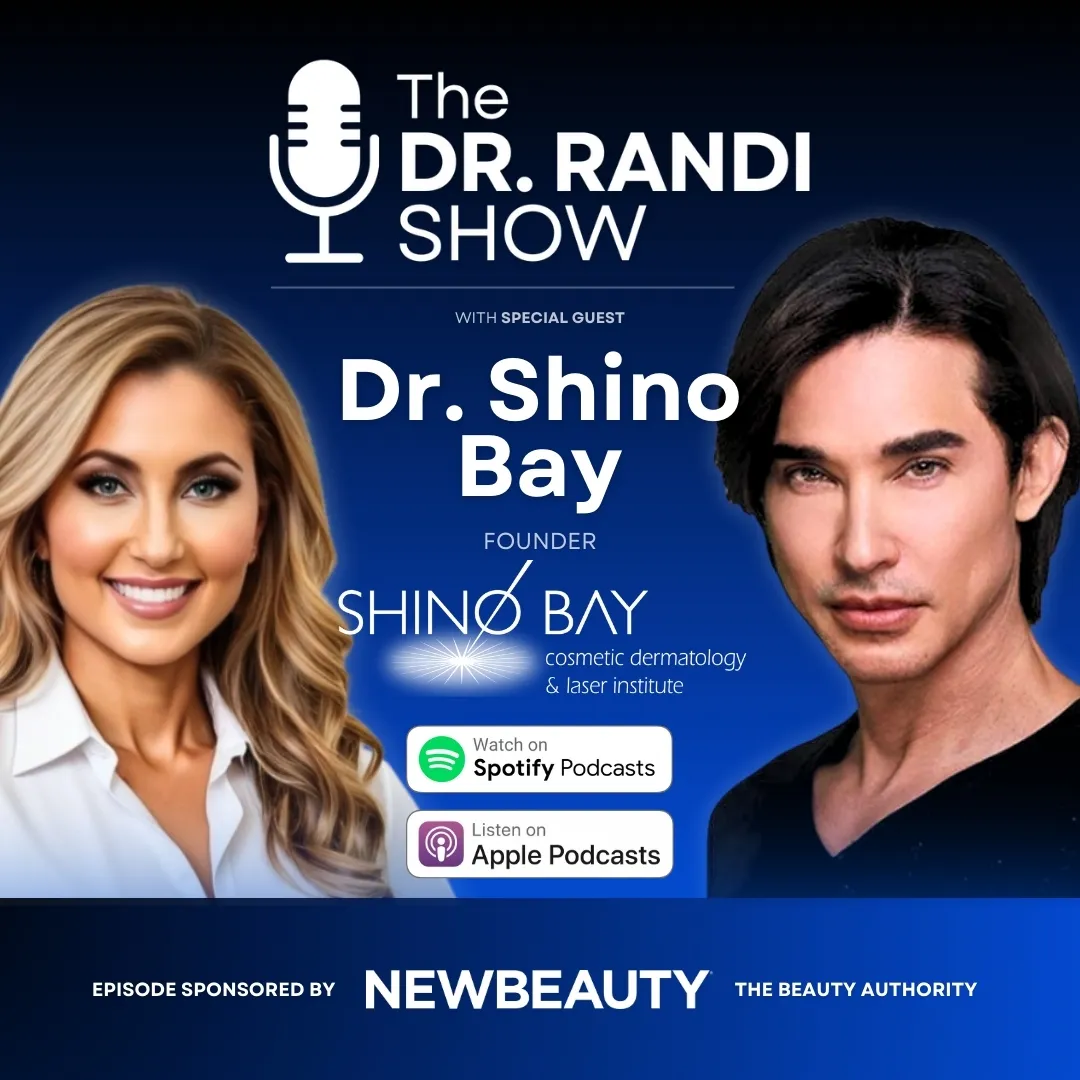
This week, Dr. Randi is joined by Dr. Shino Bay Aguilera, a world-renowned, board-certified dermatologist and global educator. Recognized as one of the most requested speakers in aesthetic medicine and the #1 Sculptra injector in the U.S., Shino Bay Aguilera is known for advancing techniques that reframe how we think about regenerative aesthetics.
In this episode, you’ll hear:
•Why bone matters most: how supra-periosteal Sculptra placement helps preserve structure and delay the signs of collapse.
•Beyond fillers: the shift from masking lines to rebuilding collagen, elastin, and fat for long-term youthfulness.
•Cellular performance enhancers: the role of micronutrients, polynucleotides, and exosomes in making every treatment work harder.
•The artistry of injection: why treating markings instead of the face is the #1 mistake injectors make, and how to see the whole picture.
•Strategic aging plans: from prevention in your 20s to bone protection in your 50s, and how to approach every decade with intention.
•Filtering the noise: the truth about what’s real, what’s hype, and how patients can cut through the social media clutter.
This isn’t about fighting time, it’s about mastering it with science, strategy, and artistry.
This episode is sponsored by NewBeauty 💄
📱 Listen and Watch on Spotify: https://spti.fi/HcZXDCA
🎧 Listen Now on Apple: https://dub.sh/5B9GkZZ
Episode FAQ
What is bioregenerative aesthetic medicine, and how is it different from traditional anti-aging injectables?
On The Dr. Randi Show, Dr. Shino Bay, a dermatologist, educator, and trainer for major aesthetic brands whom the host introduced as a leading Sculptra injector, explained his focus on bioregenerative aesthetics. Dr. Shino Bay described the goal as helping the body rejuvenate its own tissue rather than making a face appear younger for a limited time with a synthetic gel. He discussed a Sculptra technique he said differs from the on-label technique, why he views fillers as structural support rather than anti-aging, his standards for new products and devices, orthomolecular medicine, how aging changes by decade, and how he trains injectors to be artists rather than technicians. He also shared his hope of giving patients what he calls a spiritual facelift, helping them release fear about the aging process. This reflects Dr. Shino Bay’s clinical experience and is not medical advice.
What is perception drift, and how can too many small cosmetic treatments change how someone looks?
On The Dr. Randi Show, Dr. Shino Bay described perception drift, a concept he credited to an article by his friend Dr. Sabrina Fabi, as gradually doing more and more treatments to stave off aging without noticing the cumulative change. Dr. Shino Bay shared that it happened to him: starting around age 35, he did small treatments hoping to look younger later, and the change was so gradual that he did not realize he had become what he called a cartoon version of himself. He said an honest comment from his sister and seeing himself on a television appearance made him realize it, and he then spent about nine months letting everything melt out of his face before looking for what he considered better ways to address aging. He encouraged people in their twenties not to become obsessed with aging and to focus on the quality of their skin instead. This reflects Dr. Shino Bay’s personal and clinical experience and is not medical advice.
How does Sculptra work, and can placing it on the bone help slow facial aging?
On The Dr. Randi Show, Dr. Shino Bay explained that he views Sculptra, a poly-L-lactic acid injectable, as more than a collagen biostimulator. Dr. Shino Bay said that in 2009 he began placing it directly on top of the bone, a technique he described as different from the on-label technique most providers learn, because he sees bone loss in the face as a major reason people start to look elderly. Based on about 20 years of using this approach, he said he has observed slower changes in facial bone in his patients and in himself, and he believes Sculptra may help preserve the architecture of the face. He was clear that as a clinician he can only report what he observes, and said gene expression research is now being used to study what happens at the cellular level. This reflects Dr. Shino Bay’s clinical observations and is not medical advice.
Are dermal fillers anti-aging, or do they only provide structural support?
On The Dr. Randi Show, Dr. Shino Bay said he still uses injectable fillers in his practice but does not consider them anti-aging, describing them instead as structural supporters that can do amazing work for an aging face. Dr. Shino Bay said he prefers a like-for-like approach that aims to bioregenerate tissue first. He described using Renuva when the face needs fat without a fat transfer, Sculptra on the bone to help maintain bone, and options such as hyperdilute Radiesse, micronutrients, polynucleotides, and exosomes to support collagen, elastic fibers, and overall skin quality. This reflects Dr. Shino Bay’s clinical experience and is not medical advice.
How should aesthetic providers decide which new skincare products and devices are worth using?
On The Dr. Randi Show, Dr. Shino Bay said that before bringing skincare into his practice, he requires at least a white paper, a document in which the company shows the science and studies behind its claims. Dr. Shino Bay applies the same standard to energy-based devices, looking for studies on both safety and efficacy. He shared that in his younger years he made mistakes buying into hype and new technology that was expensive and did not deliver what was promised. He also cautioned that while patients today are savvy, there is a lot of misinformation and products he described as hope in a jar, which is why he uses his voice to educate both providers and consumers. This reflects Dr. Shino Bay’s clinical experience and is not medical advice.
What is orthomolecular medicine, and how are polynucleotides and poly-revitalizing micronutrients used in aesthetics?
On The Dr. Randi Show, Dr. Shino Bay said raising awareness of orthomolecular medicine is his mission this year. Dr. Shino Bay explained that the term was coined by two-time Nobel Prize winner Linus Pauling and is based on the idea that molecules in our foods can help us thrive or make us sick. He described poly-revitalizing micronutrient products, some used in Europe for decades, that in his view prime the skin so cells become more vigorous, and he said in vitro studies suggest they can amplify the results of other techniques. He noted that the United States is somewhat behind international markets in this area, and said he co-authored a U.S. study on polynucleotides with Dr. Saranya Wyles for Mayo Clinic, cautioning colleagues not to dismiss these treatments without reviewing the published research. This reflects Dr. Shino Bay’s clinical experience and is not medical advice.
How does the face age by decade, and which treatments fit each stage?
On The Dr. Randi Show, Dr. Shino Bay described aging as a series of architectural changes. Dr. Shino Bay said that from about age 18 into the late thirties, people gradually lose collagen, so he encouraged younger patients to invest in skin quality rather than trying to be overly proactive, pointing to his own experience at 35. In the forties, he said, the changes go deeper and involve fat in the face, where he uses products such as Renuva. In the fifties, he said bone in the face begins to break down, which is when he places Sculptra on the bone with the goal of maintaining the proportions of a younger looking face into later decades. He also encouraged everyone, especially women, to treat their sixties as a time to be a little more selfish with their time, say no more often, and do the things they put off, rather than waiting. This reflects Dr. Shino Bay’s clinical experience and is not medical advice.
Has social media helped or hurt the aesthetic industry?
On The Dr. Randi Show, Dr. Shino Bay described social media as having both pluses and minuses. Dr. Shino Bay said it makes information easier to find and has introduced him to meaningful techniques from colleagues around the world, and that consumers benefit from similar exposure. At the same time, he said it spreads misinformation, lets anyone with a microphone present themselves as an expert, and gives a platform to influencers who may not have the right knowledge. He urged professionals not to discredit science they have not taken the time to study, and said he tries to use social media as a tool without becoming its plaything, noting that algorithms can reinforce a person’s own biases. This reflects Dr. Shino Bay’s perspective and is not medical advice.
What is the most common mistake aesthetic injectors make, and how should injecting be taught?
On The Dr. Randi Show, Dr. Shino Bay said his biggest pet peeve when teaching is injectors who mark up the entire face every time. Dr. Shino Bay explained that marking is useful for safety and teaching, but constant marking often reflects a pattern borrowed from someone else, which can weaken the injector’s artistic eye and lead to burnout. He said he begins his master classes by deprogramming students so they learn to let each face show what it needs. He believes hands-on training is by far the best way to learn, because injectors need to use all their senses, such as feeling how each filler extrudes through the needle, to grow. His goal, he said, is to train real artists, not technicians. This reflects Dr. Shino Bay’s professional experience and is not medical advice.
What is the future of aesthetic medicine, and what is functional aesthetic medicine?
On The Dr. Randi Show, Dr. Shino Bay said the field is decoding the aging process at a cellular level, with new treatments aiming to address the hallmarks of aging. Dr. Shino Bay said bioregenerative aesthetic medicine is not the future but the present, and that providers who do not embrace it risk falling behind. He combines bioregenerative aesthetics with orthomolecular medicine in an approach he calls functional aesthetic medicine, which views each cell as a living entity that needs nutrition, protection, and hydration. He said many treatments ask a lot of aging cells through heat, energy, and chemicals, and encouraged providers to be kinder to those cells, noting that in his experience nurturing them can amplify results. This reflects Dr. Shino Bay’s clinical experience and is not medical advice.