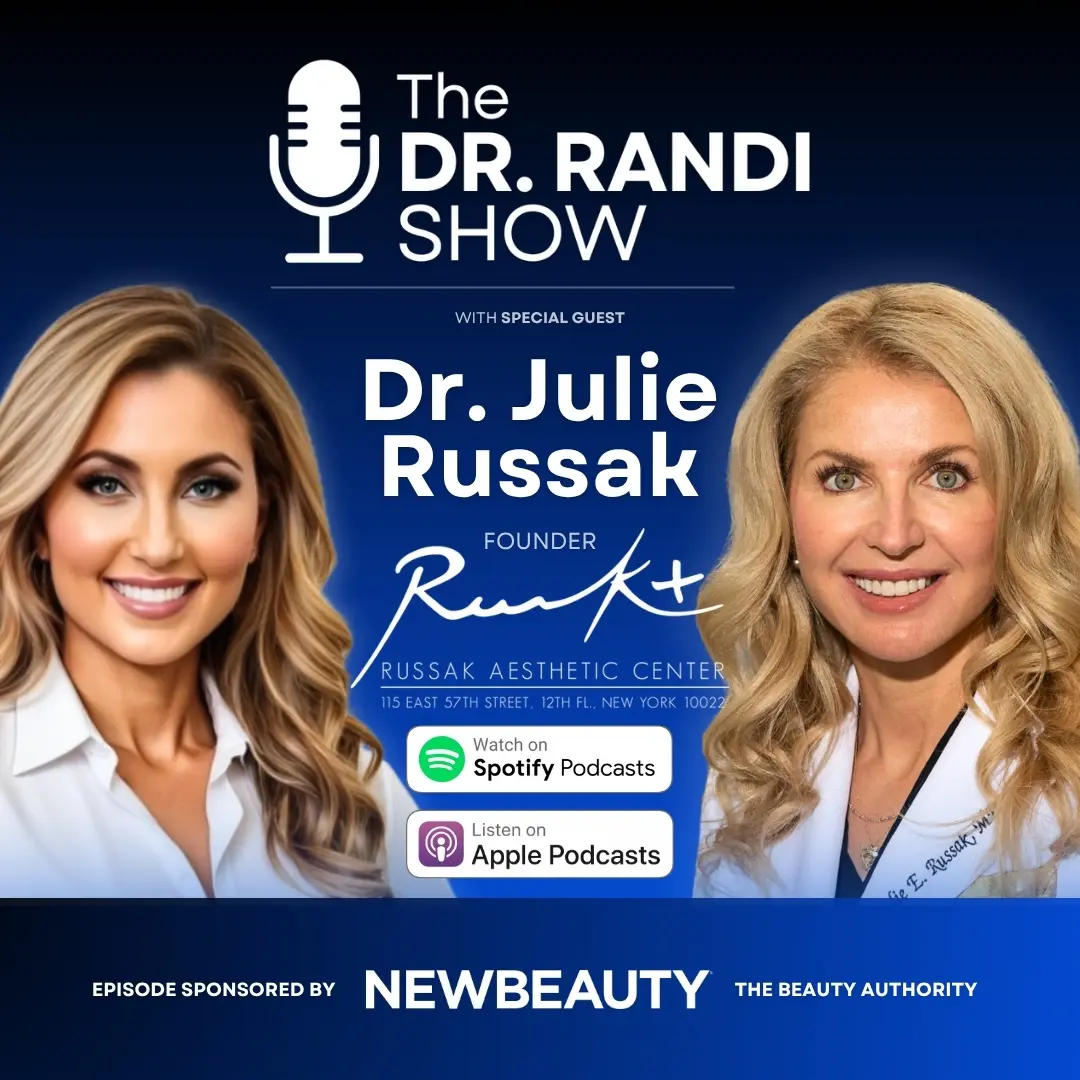
What happens when one of Manhattan’s most sought-after dermatologists takes on the challenge of redefining aging? On this episode of The Dr. Randi Show, Julie Russak, MD, FAAD shares how decades of science, patient care, and innovation have shaped her philosophy of skin health — not just as beauty, but as a marker of overall vitality.
Featured in Vogue and The New York Times, Dr. Julie Russak, MD, FAAD has built a reputation for blending regenerative medicine with a personal touch that keeps patients coming back for years. She breaks down what’s next in aesthetics, from the rise of peptide technology to the overlooked truths about eye and neck aging.
Key takeaways:
• Why regeneration — not just correction — is the future of aesthetics
• How peptides activate “reserve” cells to spark skin renewal
• The truth about eye and neck aging, and what actually works
• Why prevention beats correction at every stage of life
• The role of lifestyle, diet, and the microbiome in radiant skin
From New York’s competitive world of aesthetics to real-world patient stories, this conversation gives you a front-row seat to the science and philosophy shaping the future of dermatology.
This episode is sponsored by NewBeauty💄
📱 Listen and Watch on Spotify: https://spti.fi/0q6H88T
🎧 Listen Now on Apple: https://dub.sh/H5PfmQk
Episode FAQ
What is regenerative aesthetic medicine, and how is it changing skincare and dermatology?
On The Dr. Randi Show, Manhattan dermatologist Dr. Julie Russak, whom the host introduced as featured in Vogue and The New York Times and recognized by NewBeauty as a Top Doctor since 2014, described regeneration as the keyword in medicine right now. Dr. Russak said the biggest breakthrough is the ability to repair rather than just mask signs of aging, using molecular and intercellular science and molecules that tap into stem cells to help the skin regenerate. She discussed how she uses DefenAge peptide skincare alongside in-office procedures, why the eye area and neck show aging first, why she favors skin cycling and combination treatments, and why she talks with patients about diet and gut health. This reflects Dr. Russak’s clinical experience and is not medical advice.
What is DefenAge, and how do defensin peptides work on aging skin?
On The Dr. Randi Show, dermatologist Dr. Julie Russak explained that she has offered DefenAge in her practice for a number of years and pairs it with the regenerative procedures she performs. Dr. Russak said DefenAge is built around defensin molecules, which in her description activate reserve cells at the bottom of the skin that have not traditionally been used for skin regeneration and bring them toward the surface, so healthier, younger cells can do more of the work. She contrasted this with older approaches that she said keep tapping into the same cells, and noted that the technology was originally discovered for wound healing before being translated into an aesthetic product. This reflects Dr. Russak’s clinical experience and is not medical advice.
How is peptide skincare different from retinol and vitamin C, and can sensitive skin use it?
On The Dr. Randi Show, Dr. Julie Russak said DefenAge is very different from vitamin C, retinol, and growth factors, but not a replacement for them. Dr. Russak compared healthy skincare to eating the whole rainbow of vegetables, explaining that she likes to combine primordial cell support, antioxidants, and a retinol because they work synergistically. She noted that some patients find retinol too harsh or vitamin C too irritating, and said DefenAge uses peptides that work through a different pathway, with no acids or irritants involved. In her experience, patients with very sensitive skin, a compromised skin barrier, rosacea, or acne can use it. This reflects Dr. Russak’s clinical experience and is not medical advice.
Why do the under-eye area and neck show aging first, and can skincare help with puffiness and dark circles?
On The Dr. Randi Show, Dr. Julie Russak explained that the skin around the eyes is the thinnest on the body, has no oil glands, and is under constant stress from blinking and smiling, so exfoliants are not a good fit there and the focus should be on protecting and repairing the skin. Dr. Russak described puffiness and dark circles as a multifactorial problem, and said regenerating the skin to make it a little thicker, with a bit more collagen and strength, is why she feels the DefenAge eye product helps with several concerns at once. She called the neck one of the toughest areas because it has few support structures, no fat cells, and limited dermal cells for repair, and said looking down at phones is contributing to tech neck in younger and younger patients. This reflects Dr. Russak’s clinical experience and is not medical advice.
How long does it take to see results from a neck cream?
On The Dr. Randi Show, Dr. Julie Russak explained that the DefenAge 6-Week Perfection Neck Tightening Cream is named for six weeks because, in her words, studies have shown patients starting to see results at about six weeks. Dr. Russak said it takes time for the body to produce collagen and elastin and for cells to regenerate, and that the results do not stop at six weeks. She noted that seeing early progress encourages her patients to keep using it, which she summed up as getting efficacy from compliance. The host also pointed to the brand’s roughly 30 clinical studies as unusual for a skincare line. This reflects Dr. Russak’s clinical experience and is not medical advice.
What is skin cycling, and how can skincare be paired with RF microneedling and biostimulatory injections?
On The Dr. Randi Show, Dr. Julie Russak said she believes in skin cycling and that her practice rotates products by season, but mostly around the procedures patients have in the office. Dr. Russak said she often pairs DefenAge with biostimulatory injections, which stimulate collagen and elastin production, to create a synergistic effect. She called radiofrequency microneedling and DefenAge the perfect combination, explaining that the treatment helps deliver the product deeper into the skin. Many of her patients use it between procedures to add value to the in-office treatments they receive. This reflects Dr. Russak’s clinical experience and is not medical advice.
When should you start anti-aging skincare, and can it be used on the body?
On The Dr. Randi Show, Dr. Julie Russak said prevention works much better than correction. Because it is well understood that the skin around the eyes shows the first signs of aging, Dr. Russak encourages patients to start early rather than wait to repair, and she noted that people tend to focus on the face and overlook the neck until signs appear. She added that it is still worthwhile to start once laxity and a loss of collagen and elastin become visible. Her patients report that their skin feels healthier, and she said the same approach can be used beyond the face and neck on areas such as the upper arms, thighs, and elbows. This reflects Dr. Russak’s clinical experience and is not medical advice.
Are any aesthetic treatments overhyped, and which skincare products matter most?
On The Dr. Randi Show, Dr. Julie Russak said she does not believe any single treatment is overhyped, because care should be individualized, though overusing any one thing can be a problem. Comparing aesthetics to training only your biceps at the gym, Dr. Russak said the best results come from combining modalities such as energy devices, biostimulatory molecules, injectable and topical peptides, and emerging options like stem cells and exosomes. Asked which products she would prioritize if a patient could only use three for life, she named a biostimulatory molecule and some form of microbiome support and stimulation. This reflects Dr. Russak’s clinical experience and is not medical advice.
How is dermatology moving from quick fixes toward long-term regenerative care?
On The Dr. Randi Show, Dr. Julie Russak said dermatology was long a transactional field, where patients came in for Botox or filler, expected instant results, and then disappeared for a long time. Dr. Russak said that is changing and needs to change further, with patients investing in themselves early for longer term results that may not show the day they leave the office. She noted that Botox is now used more to prevent than to treat, and said the field needs to move away from overdone looks and overdone lips toward healthy, individual faces rather than one standard for everybody. She shared that when she began her regenerative practice, patients were often surprised that a dermatologist asked about their diet and gut health, and that she wishes she had focused on healthy living from the inside in her twenties. This reflects Dr. Russak’s clinical experience and is not medical advice.
How can you build a simple skincare routine when there are too many options?
On The Dr. Randi Show, Dr. Julie Russak advised listeners who feel overwhelmed to focus on what is healthy for their body rather than on trends or hype. Dr. Russak said skincare does not have to be complicated or ten steps, but it should be smart: in the morning, protect the skin from environmental and UV damage with antioxidants and SPF, and at night, when the skin regenerates, use peptides and retinols. She also talks with patients about diet and the gut microbiome, noting that what the body absorbs matters as much as what you eat, and she emphasized exercise and overall mental well-being as part of the picture. This reflects Dr. Russak’s clinical experience and is not medical advice.