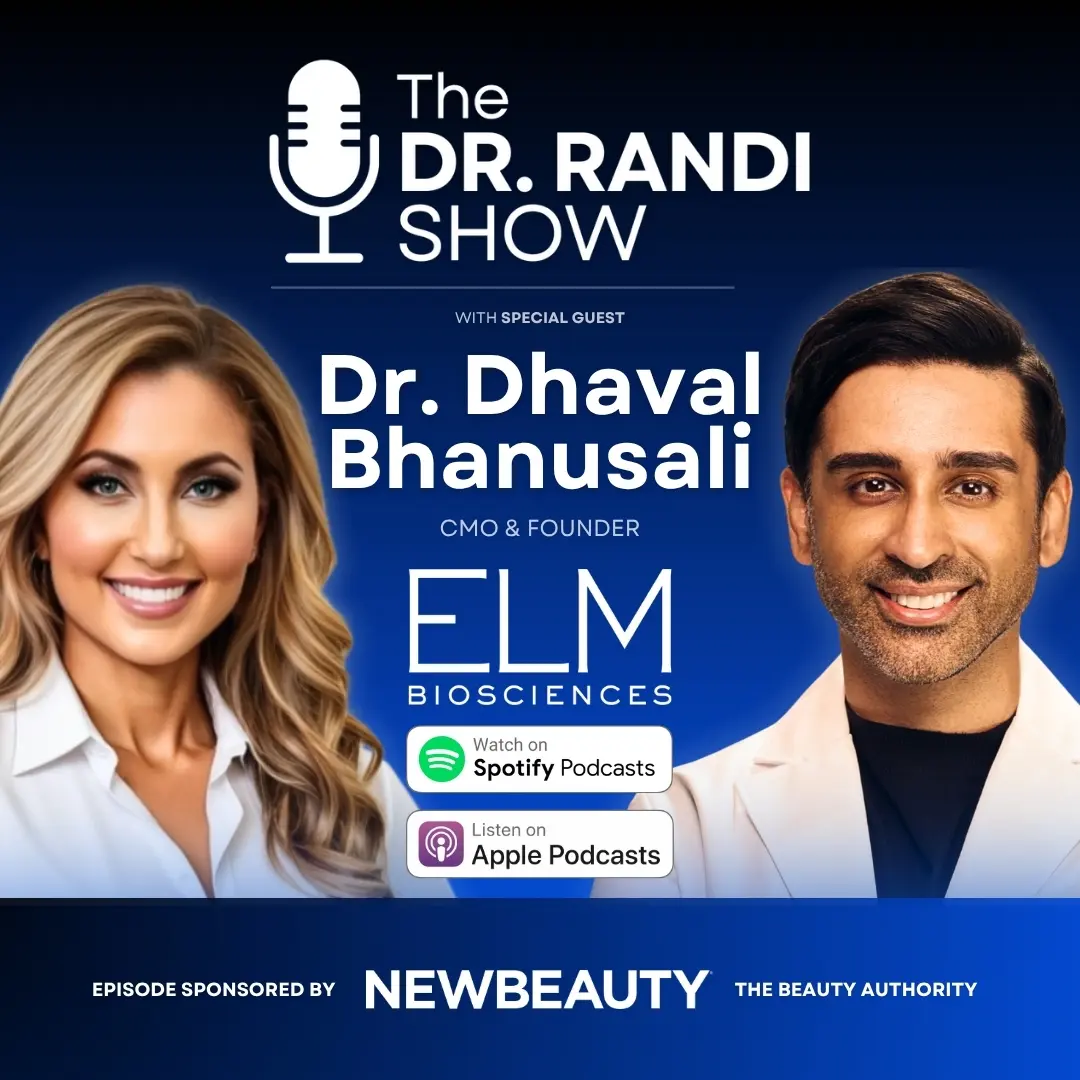
What happens when Martha Stewart personally tests every prototype, and Hailey Bieber’s go-to dermatologist builds the formulas? You get ELM, a science-first skincare project designed for results, not hype.
This week, Dr. Randi sits down with Dr. Dhaval Bhanusali, the formulator behind household-name brands and A-list routines, to talk about ELM’s debut:
• A next-gen antioxidant serum built to go beyond the limits of traditional vitamin C
• A companion “Inner Dose” supplement rooted in the few ingestibles dermatologists actually recommend
In this conversation, you’ll discover:
• Why many vitamin C serums fall short (and how ELM takes a different approach to antioxidants)
• How Martha Stewart’s hands-on testing set an exceptionally high standard
• The collective insight of 350 dermatologists that shaped the launch
• Why “aging well” is replacing “anti-aging” in serious skincare
• How ELM is shrinking the gap between lab breakthroughs and your bathroom shelf
It’s celebrity meets science, with a lab-to-patient approach that shows what really works in skincare.
This episode is sponsored by NewBeauty 💄
📱 Listen and Watch on Spotify: https://spti.fi/Pv36HSn
🎧 Listen Now on Apple: https://dub.sh/5A4RmUM
Episode FAQ
What is Elm Biosciences, the skincare line from Martha Stewart and a dermatologist?
On The Dr. Randi Show, Dr. Dhaval G. Bhanusali, a board certified dermatologist who helped build Rhode with Hailey Bieber from its earliest days, worked on the initial development team for Neutrogena Hydro Boost, and founded the pharma tech platform Skin Medicinals, discussed Elm Biosciences, the skincare line he co-founded with Martha Stewart. He described Elm as a science brand rather than a celebrity brand, with Martha lending her platform, and said it launched with two products: the A3O Elemental Serum and the Inner Dose daily skin supplement. He shared that the brand was five years in the making, that hundreds of dermatologists have joined the platform, and that its guiding idea is to define trends rather than chase them. This reflects Dr. Bhanusali’s personal and professional experience and is not medical advice.
How did Martha Stewart’s first skincare line come together?
On The Dr. Randi Show, Dr. Dhaval G. Bhanusali said the partnership grew organically. He shared that Martha Stewart was his first patient before his office even opened, more than six years ago, and that the two became close friends. He described an informal Project Elm in which he would send her formulas and ingredients to try, and said she was his muse, holding everything to a very high standard. When some of the formulas worked better than they expected, they decided to bring them to more people. He described their approach as Martha’s farm to table and his lab to patient, explaining that his office runs validation studies for ingredient suppliers and that he wanted to bring promising science to people faster while still doing it the right way. This reflects Dr. Bhanusali’s personal and professional experience.
Why do some dermatologists think vitamin C serums have room for improvement?
On The Dr. Randi Show, Dr. Dhaval G. Bhanusali compared vitamin C to milk: something we were all told was essential, but worth reexamining. In his view, the vast majority of vitamin C serums are not stable once the bottle is opened, many need a very low pH, and many can be pro-inflammatory or irritating, including some forms marketed for sensitive skin. He shared that he personally cannot tolerate many vitamin C products. He said he has nothing against vitamin C and that some brands do it well, but that this gap led him to ask whether there is a better antioxidant for protecting skin from free radicals. This reflects Dr. Bhanusali’s clinical perspective and is not medical advice.
What is in the Elm A3O Elemental Serum, and what is it designed to do?
On The Dr. Randi Show, Dr. Dhaval G. Bhanusali described the A3O Elemental Serum as a multipurpose serum built around the A3O complex, reflecting his less is more philosophy. He explained that it starts with a photostable antioxidant designed not to break down after the bottle is opened, noting that a small amount of serum visible at the bottom of the bottle is there on purpose to show that stability. He said the formula uses a physical quencher for reactive oxygen species, includes ingredients he said were found to have collagen stimulating properties, and aims to be anti-inflammatory rather than pro-inflammatory, with supporting ingredients such as squalane, hyaluronic acid, and blue tansy, plus a natural fragrance. This reflects Dr. Bhanusali’s description of the formula and is not medical advice.
What is in the Elm Inner Dose supplement, and why pair a supplement with skincare?
On The Dr. Randi Show, Dr. Dhaval G. Bhanusali said he is not a big supplement guy and feels many supplements are more marketing than substance, but that there are certain ingredients dermatologists commonly recommend. He said Inner Dose was designed to bring those together in one capsule, including Polypodium leucotomos, which he called probably the most recommended supplement in dermatology offices for patients concerned with sun damage, pigment, and preventive aging, along with astaxanthin, turmeric, and vitamin D, which he said comes up often in his hair loss work. He encouraged anyone considering an oral supplement to check with their own physician or healthcare provider first. This reflects Dr. Bhanusali’s professional perspective and is not medical advice.
Why did Elm take five years to develop and involve 350 dermatologists?
On The Dr. Randi Show, Dr. Dhaval G. Bhanusali said rushing leads to the most convenient decision rather than the right one, and that there was no rush with Elm. He described going through countless samples over five years and said every percentage in a formula makes a difference. On the more than 350 dermatologists involved, he said some are far more involved than others, and that the goal is for the brand to reflect the expertise of dermatology colleagues more than his or Martha Stewart’s personal views, calling it a we not me approach rather than handing a formula to a contract manufacturer. This reflects Dr. Bhanusali’s personal and professional experience.
Who is Elm skincare designed for?
On The Dr. Randi Show, Dr. Dhaval G. Bhanusali said he first thought Elm might be for a 40 plus or 50 plus crowd, but realized it is not about a specific age or sex. Instead, he described it as being for people who want to age well and who value products that simply work over trends. He pointed to Martha Stewart as an example of living well at 84, and said he sees more people approaching their health proactively rather than reactively. He also mentioned emerging science around cellular senescence, while noting he is cautious about how that topic is discussed because of the many unproven claims in the market. This reflects Dr. Bhanusali’s personal and professional perspective and is not medical advice.
How can you tell if a skincare formula is actually effective, and where is skincare heading?
On The Dr. Randi Show, Dr. Dhaval G. Bhanusali compared formulating to cooking: a little pinch of salt goes a long way, and too much changes the whole dish. He said ingredient percentages matter, giving the example that niacinamide at five or six percent can behave differently than at one or two percent, so an ingredient appearing low on a label is not necessarily a flaw. He said the best formulas focus on how ingredients work together, and that marketing may win a first purchase but repeat purchases depend on quality and results. Looking ahead, he said he sees skincare becoming more results driven as consumers become more educated, summing up his message as science wins. This reflects Dr. Bhanusali’s professional perspective and is not medical advice.
What do dermatologists think about retinol, exfoliation, toners, and other popular skincare trends?
In the speed round on The Dr. Randi Show, Dr. Dhaval G. Bhanusali shared quick personal takes. He called retinol a daily must and said preventive Botox can be a yes for the right patient. He said many people have over exfoliated and compromised their skin barrier, so he prefers exfoliating one to two times a week, and suggested skipping traditional alcohol based toners. He said hyaluronic acid is overhyped in how it has been marketed, clean beauty labels are largely marketing, collagen supplements still need better data before he would recommend them, and SPF 100 is great if you will wear it but not a must. He called niacinamide a great supporting ingredient that can help people tolerate actives, said he is a big fan of well studied peptides, eye creams, and skin cycling, and said sheet masks and under eye masks can be useful because occlusion can increase absorption of good actives. This reflects Dr. Bhanusali’s personal opinions and is not medical advice.
Are at-home microneedling, red light therapy, and other beauty devices worth it compared with in-office treatments?
In the speed round on The Dr. Randi Show, Dr. Dhaval G. Bhanusali said at home devices can be helpful when used correctly, but that he prefers in office treatments for their strength and supporting data. He said microneedling should be clinic only, explaining that in an uncontrolled setting it can do more harm than good, and that he has seen infections and damage to hair follicles. He described himself as a big red light fan, mostly in office, and said at home versions help but probably not as much as often claimed. He called himself a laser guy, said it matters who you go to, and described facials as part of a regimen rather than the whole regimen. He said dermaplaning can be helpful with a well designed blade, and that gua sha and jade rollers offer temporary lymphatic drainage along with a meaningful moment of mindfulness. This reflects Dr. Bhanusali’s personal opinions and is not medical advice.