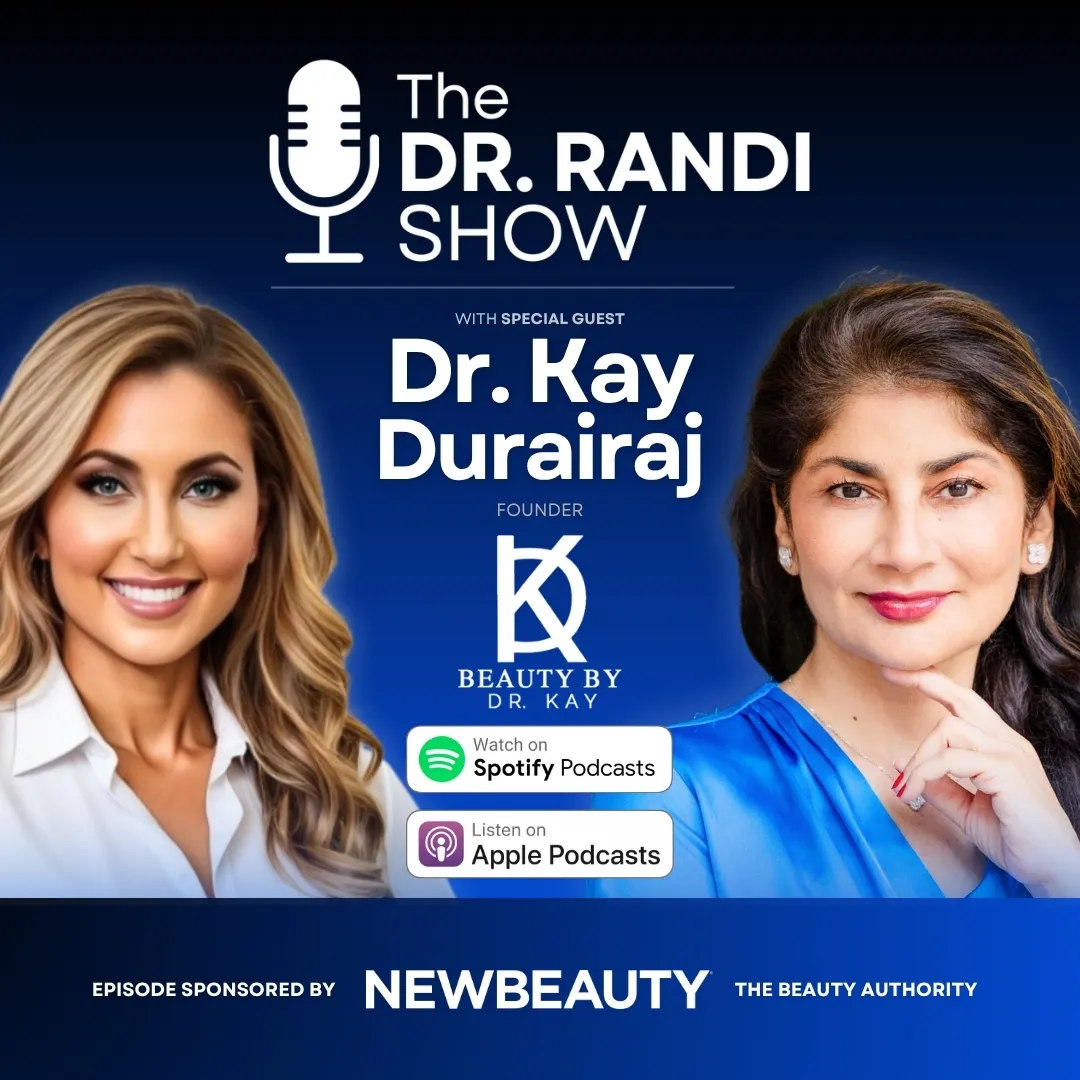
She built an empire where beauty meets science, and she’s rewriting the rules of modern aesthetics. In this powerhouse episode of The Dr. Randi Show, surgeon, educator, and innovator Kay Durairaj, MD, FACS shares how she’s shaping the future of beauty through science, education, and empowerment.
From collagen banking to bio-regenerative medicine, Dr. Kay takes listeners inside the real next wave of aesthetics: longevity, peptides, molecular skincare, and the art of the natural look. She reveals how injectors are being retrained to think like scientists, why “Ozempic face” is changing the filler game, and the treatments she ranks 10 out of 10 for lasting results.
A sharp, forward-thinking conversation that captures where aesthetics is headed, and why the future of beauty belongs to those who understand the science behind it.
Sponsored by NewBeauty💄
📱 Listen and Watch on Spotify: https://spti.fi/jjL72Pa
🎧 Listen Now on Apple: https://dub.link/AVJH7Kh
Episode FAQ
What is new in medical aesthetics, and where is the industry headed?
On The Dr. Randi Show, surgeon, educator, and injector trainer Dr. Kay Durairaj shared her view of where aesthetics is going next. She described the newest frontier as working at the level of the molecule, including bio regenerative therapies, peptides, polynucleotides, and longevity medicine, and she highlighted collagen biostimulators, a topical rapamycin she is helping develop, and an integrative approach that looks at overall health alongside the face. Dr. Durairaj also emphasized that she only recommends treatments backed by science and clinical studies, and that she encourages patients to embrace natural beauty rather than chase perfection. This reflects Dr. Durairaj’s clinical experience and is not medical advice.
What is topical rapamycin, and how could it help with skin aging?
During this episode of The Dr. Randi Show, Dr. Durairaj shared that she is working with a company to develop a topical rapamycin cream. She explained that rapamycin is known as an oral tablet that has been shown to extend lifespan in animals such as fruit flies, rats, and mice, and that it is speculated to have longevity benefits in humans. In her description, applying it topically is intended to help older, senescent fibroblasts behave more like younger, active ones so they produce collagen closer to their earlier levels. She noted that this treatment has not yet been released, so it should be viewed as an emerging area rather than an available option. This reflects Dr. Durairaj’s clinical experience and is not medical advice.
What are collagen biostimulators, and what can they be used for?
On The Dr. Randi Show, Dr. Durairaj called collagen biostimulators a 10 out of 10 and said the industry is only at the beginning of learning what they can do. In her practice, she uses them for midface lifting and rejuvenation, for improved skin quality, and to help address facial fat loss associated with GLP-1 medications, sometimes called Ozempic face. She described placing them lateral to the facial ligaments to create an upward, tightening effect, and said that priming the skin first with nutrients, peptides, or polynucleotides may help boost collagen further. She also noted that collagen takes roughly 60 to 90 days to build, so faster options such as hyaluronic acid filler may make sense when someone wants results sooner. This reflects Dr. Durairaj’s clinical experience and is not medical advice.
What are salmon DNA polynucleotide treatments, and why are they popular?
Dr. Durairaj told The Dr. Randi Show that salmon DNA treatments, also called polynucleotides, are among the most requested treatments she sees right now. She explained that these are DNA nucleotides that act as building blocks to help repair damage in aging skin cells. In her practice, they are used before laser treatments, on the same day as a collagen stimulator, and after procedures to support healing, such as about a week after a facelift. She also mentioned recombinant platelet derived growth factor products as an alternative to drawing and spinning PRP. These are her clinical observations, and results can differ from person to person. This reflects Dr. Durairaj’s clinical experience and is not medical advice.
What is the hyperdilute Radiesse midface technique?
On The Dr. Randi Show, Dr. Durairaj described her hyperdilute Radiesse midface technique as one of the most game changing approaches in her practice over the past year. She explained that it is a multilayer approach, placing product on the bone, within the facial fat pads, and in the deep and sometimes superficial dermis, with the goal of a global lifting, tightening, and brightening effect. She shared that the technique was published as an open access article in Aesthetic Surgery Journal Open Forum, and that it is tailored to where each person has lost facial fat, whether from aging or from GLP-1 weight loss. This reflects Dr. Durairaj’s clinical experience and is not medical advice.
How can you combine or stack aesthetic treatments for better skin?
Dr. Durairaj shared her favorite treatment combination on The Dr. Randi Show. She described priming the skin with a polynucleotide treatment, and sometimes exosomes, before a collagen stimulator, and then about four weeks later adding a skin tightening treatment such as microneedling with radiofrequency or a light CO2 laser to remove the top layers of sun damaged skin. She also called microneedling an underrated treatment, saying that in her experience a series of three to four sessions can significantly boost collagen with minimal downtime, which may appeal to people who are not ready for surgery or filler. This reflects Dr. Durairaj’s clinical experience and is not medical advice.
How do you get natural looking injectable results without looking overfilled or frozen?
On The Dr. Randi Show, Dr. Durairaj explained how she approaches patients who want to look refreshed without looking like they have had work done. She assesses the face in upper, middle, and lower thirds to find where volume has been lost, and when needed she dissolves previous filler and starts fresh. She said she still values hyaluronic acid filler when used judiciously in small, carefully placed amounts, though her practice has shifted more toward collagen stimulators. For those worried about a frozen look, she described taking a very light hand with neurotoxin and matching the specific toxin to each patient. She also mentioned upper eyelid surgery as a helpful option when excess skin is the main concern. This reflects Dr. Durairaj’s clinical experience and is not medical advice.
How much filler does it take to see results, and how often should you get treatments?
Dr. Durairaj told The Dr. Randi Show that one of the biggest misconceptions she hears is that one syringe of filler can do the work of a whole facelift. She explained that product has to be budgeted per area of the face, and that restoring areas with deflation and volume loss often takes five or six syringes spread out over time rather than all at once. She encouraged patients to slow down and give products time to settle, and noted that as people age, maintenance tends to increase, often with treatments like microneedling, peels, and energy devices in between. She also said it is okay to choose not to do anything, and that small facial characteristics are part of what makes each person special. This reflects Dr. Durairaj’s clinical experience and is not medical advice.
What is an integrative or longevity approach to aesthetics?
On The Dr. Randi Show, Dr. Durairaj described integrative aesthetics as the direction that excites her most. In her vision, an aesthetic practice looks at the whole person, including blood work, nutrient and vitamin levels, hormones, inflammation, and treatments such as IV drips or peptides, alongside the face itself. She explained that her practice uses AI analysis and 3D facial scanning to track skin quality and facial aging patterns over time, and she anticipates future testing such as DNA methylation patterns to help guide care. She framed this as bringing longevity science into aesthetics, which is her perspective on where the field is headed. This reflects Dr. Durairaj’s clinical experience and is not medical advice.
How do popular treatments like threads, lip flips, and masseter Botox compare?
In a speed round on The Dr. Randi Show, Dr. Durairaj rated a range of treatments from 1 to 10 based on her own experience. She gave top marks to biostimulators, preventative neurotoxin, non-surgical nose contouring, jawline contouring, gummy smile neurotoxin, in office red light facials, retinol, hyaluronic acid serums, peptide skincare, and skin cycling. She gave threads a 1 unless they are anchored and sutured, rated lip flips an 8, filler chin augmentation and hair restoration injections a 9, fat dissolving injections an 8, masseter slimming with neurotoxin a 7, cellulite treatments a 7, and radiofrequency microneedling a 5. She explained that she is cautious with masseter slimming for many women because of her concern about long term jawbone density, and that she is careful with at home red light masks and prefers other options over cryo facials. These ratings are her personal opinions. This reflects Dr. Durairaj’s clinical experience and is not medical advice.