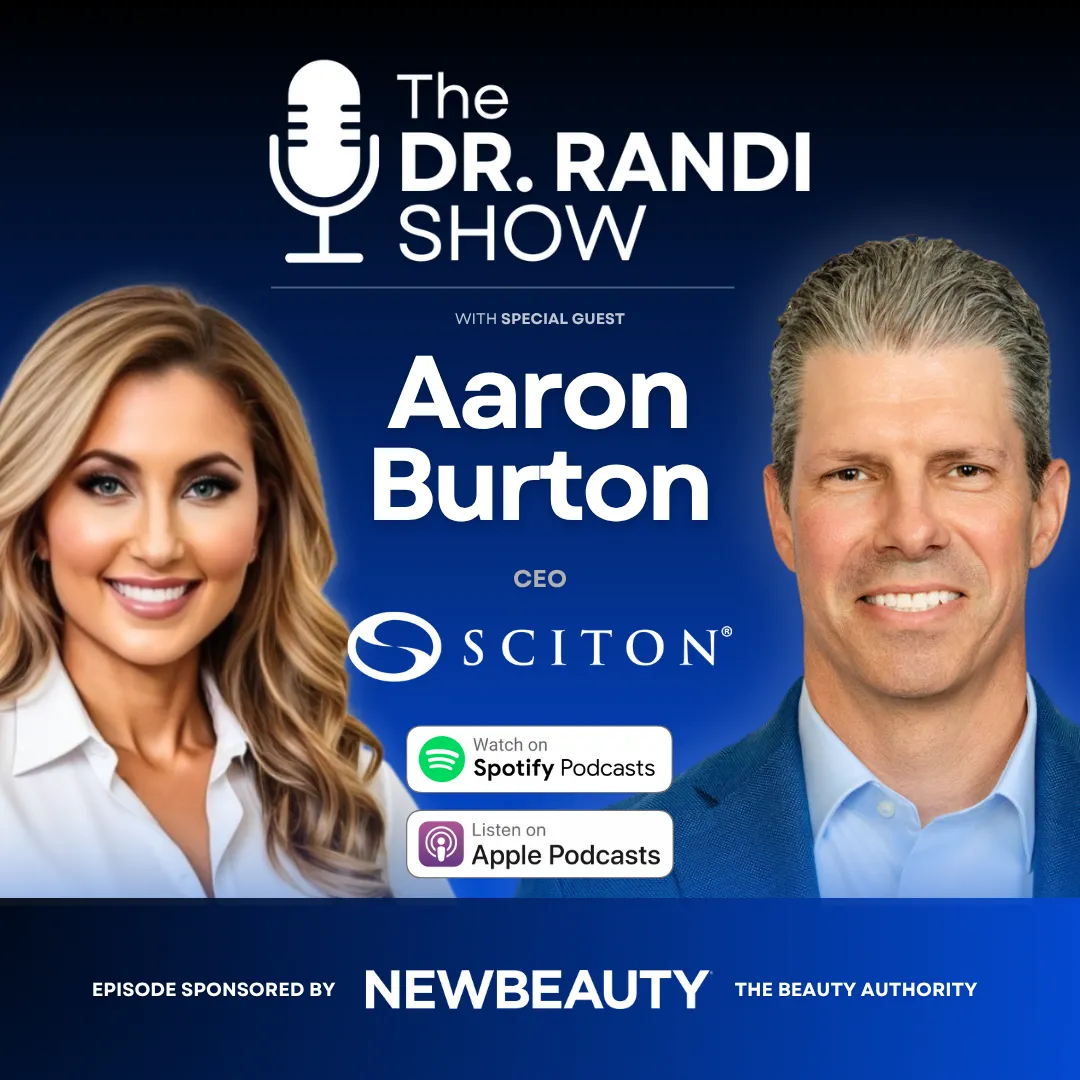
In this standout episode of The Dr. Randi Show, I sit down with Aaron Burton, the dynamic CEO behind SCITON, one of the most influential and conversation-shifting brands in aesthetics. From Moxi to Halo to BBL HERO, Sciton’s award-winning devices don’t just set trends, they define them. Patients ask for them by name, providers swear by them, and the results dominate feeds, timelines, and treatment menus everywhere.
Aaron opens up about leading a company that’s built iconic technologies, transformed skin rejuvenation, and reshaped how an entire generation cares for their skin. Together, they dive into:
• Why devices like Moxi, BBL HERO, and Halo have become cultural phenomena
• The rise of pre-juvenation and why younger patients are choosing energy-based treatments
• How Sciton continues to innovate in a crowded market, and why loyalty to the brand is unmatched
• The launch of Halo Tribrid: three wavelengths in one pass, merging power, speed, and personalized results
• What “downtime” really means today and how Sciton is rewriting expectations
• The future of skin, technology, and the emotional impact of looking good and feeling good
Aaron also takes listeners inside Sciton’s unique culture: an employee-owned company built on loyalty, long-term thinking, and a mission to create products that genuinely improve people’s lives.
If you want a front-row seat to where the aesthetic device world is going next, and why Sciton continues to lead the movement, this is an episode you won’t want to miss.
Sponsored by NewBeauty
📱 Listen and Watch on Spotify: https://spti.fi/MGBPvE2
🎧 Listen on Apple Podcasts: https://dub.link/daNeR3J
Episode FAQ
What is Sciton, and what did this episode of The Dr. Randi Show cover about laser and light treatments?
On this episode of The Dr. Randi Show, host Dr. Randi Boyette spoke with Aaron Burton, CEO of Sciton, the aesthetic device company behind MOXI, BBL HERO, HALO, and the new HALO TRIBRID. Aaron Burton, who has been with Sciton for almost 15 years and has led it for almost five, walked through how each device works, what downtime looks like, how often treatments are typically repeated, how patients can match a treatment to their skin concern, and why he sees demand shifting toward prevention. He also shared how Sciton’s employee ownership shapes its culture. The answers below reflect Aaron Burton’s perspective and are not medical advice.
What is the MOXI laser, and why is it popular for prejuvenation?
On The Dr. Randi Show, Aaron Burton explained that Sciton launched MOXI in mid 2020, just after COVID, and that it has become the company’s number two product by treatment volume. He described it as a prejuvenation treatment with very little downtime that people typically repeat two to four times a year to get ahead of aging rather than correct it later. He noted that MOXI was named Best Laser Treatment for Sun Damage in the 2025 NewBeauty Awards, which he credited to its combination of strong results and minimal downtime. This reflects Aaron Burton’s perspective and is not medical advice.
What is BBL HERO, and what does BBL stand for?
Speaking on The Dr. Randi Show, Aaron Burton clarified that BBL stands for BroadBand Light and HERO stands for High Energy Rapid Output. He said Sciton first launched BBL in 2004 and that it has remained the company’s number one selling device and consumer treatment. According to Aaron Burton, BBL targets browns and reds in the skin, and the HERO version moves continuously across the skin instead of using a slower stamping technique, which makes it faster and practical for the face, chest, neck, shoulders, back, and legs. He said many patients see a strong result after a single treatment. This reflects Aaron Burton’s perspective and is not medical advice.
What is the HALO hybrid fractional laser, and how does it work?
On The Dr. Randi Show, Aaron Burton described HALO as what he believes is still the world’s only hybrid fractional laser, combining an ablative laser and a non-ablative laser in one device. He explained that it pairs the depth of the non-ablative wavelength with the more superficial ablative wavelength, so it can address browns and reds along with fine lines and wrinkles. Aaron Burton said HALO launched about 10 years ago and was Sciton’s first move into non-ablative treatment, opening the door for dermatologists and other providers beyond plastic surgeons. This reflects Aaron Burton’s perspective and is not medical advice.
What is the HALO TRIBRID laser, and how is it different from HALO and MOXI?
Aaron Burton told The Dr. Randi Show that the simplest way to describe the HALO TRIBRID is HALO and MOXI put together. He explained that the provider rolls a single handpiece over the skin while it fires three wavelengths: the non-ablative 1470 nm and ablative 2940 nm channels from HALO, plus the 1927 nm wavelength used in MOXI. According to Aaron Burton, a patient who previously would have needed both a HALO and a MOXI can now have them in one pass, and he said the treatment takes about nine minutes. He shared that he had his own first HALO TRIBRID treatment about two months before the recording. This reflects Aaron Burton’s personal experience and is not medical advice.
How much downtime is there after HALO TRIBRID and other Sciton laser treatments?
On The Dr. Randi Show, Aaron Burton said downtime depends on how you define it and on how aggressive the treatment is. He described MOXI as showing very little, BBL as temporarily darkening pigment as it comes to the surface, and HALO and HALO TRIBRID as a bit more intensive. After HALO TRIBRID, he said skin typically looks red or sunburned and feels like sandpaper until it flakes off about four or five days later, though many people can still return to work the next day with a tinted moisturizer. Aaron Burton added that HALO TRIBRID settings are flexible, so a provider can choose a milder treatment for someone who needs to be back at work tomorrow or a more intensive one for someone preparing for an event. This reflects Aaron Burton’s perspective and is not medical advice.
Which laser treatment delivers the most dramatic results for wrinkles and sun damage?
When asked on The Dr. Randi Show which treatment delivers the biggest wow factor, Aaron Burton said it depends on the goal. For pigment and sun damage, he pointed to BBL. For deeper fine lines, wrinkles, and texture, he called full field erbium resurfacing, Sciton’s original product, the wow of all wows, noting it is often performed by plastic surgeons alongside a facelift. He cautioned that full field resurfacing removes layers of skin and comes with significant downtime, and that most people prefer lighter fractional treatments like MOXI or HALO TRIBRID. This reflects Aaron Burton’s perspective and is not medical advice.
How often should you repeat MOXI, BBL, or HALO treatments?
Aaron Burton explained on The Dr. Randi Show that frequency depends on whether a patient is focused on prevention or correction. As general examples, he said MOXI is often done about four times a year, BBL two to four times a year, and HALO once or twice, while a full field or other aggressive resurfacing treatment may be a once in a lifetime procedure. In his words, the more corrective and aggressive the treatment, the less often it is done. This reflects Aaron Burton’s perspective, and a provider should set the right schedule for each person. It is not medical advice.
How do you choose the right laser treatment for sun damage, redness, or fine lines?
On The Dr. Randi Show, Aaron Burton offered a general guide: BBL for browns and reds, HALO TRIBRID for more aggressive work on fine lines and wrinkles, and MOXI as the less aggressive option. He stressed that the real answer is to see an experienced provider, explaining that Sciton devices have built-in safety limits but are highly customizable, so the provider can tailor settings to each patient’s goals. His advice for anyone nervous about lasers was not to be scared, to take it slow, and to do your homework on providers and treatments. This reflects Aaron Burton’s perspective and is not medical advice.
Are aesthetic patients shifting from correction to prevention?
Aaron Burton told The Dr. Randi Show that he sees a clear trend toward prevention, with Sciton’s non-ablative, lower downtime treatments growing fastest. He estimated that 50,000 or more BBL treatments are performed each week, with MOXI not far behind. He added that he had been told skin resurfacing recently moved to number two in The Aesthetic Society’s procedure rankings, behind Botox, which he attributed to more people learning that modern laser treatments are far gentler than older CO2 approaches. This reflects Aaron Burton’s perspective and is not medical advice.