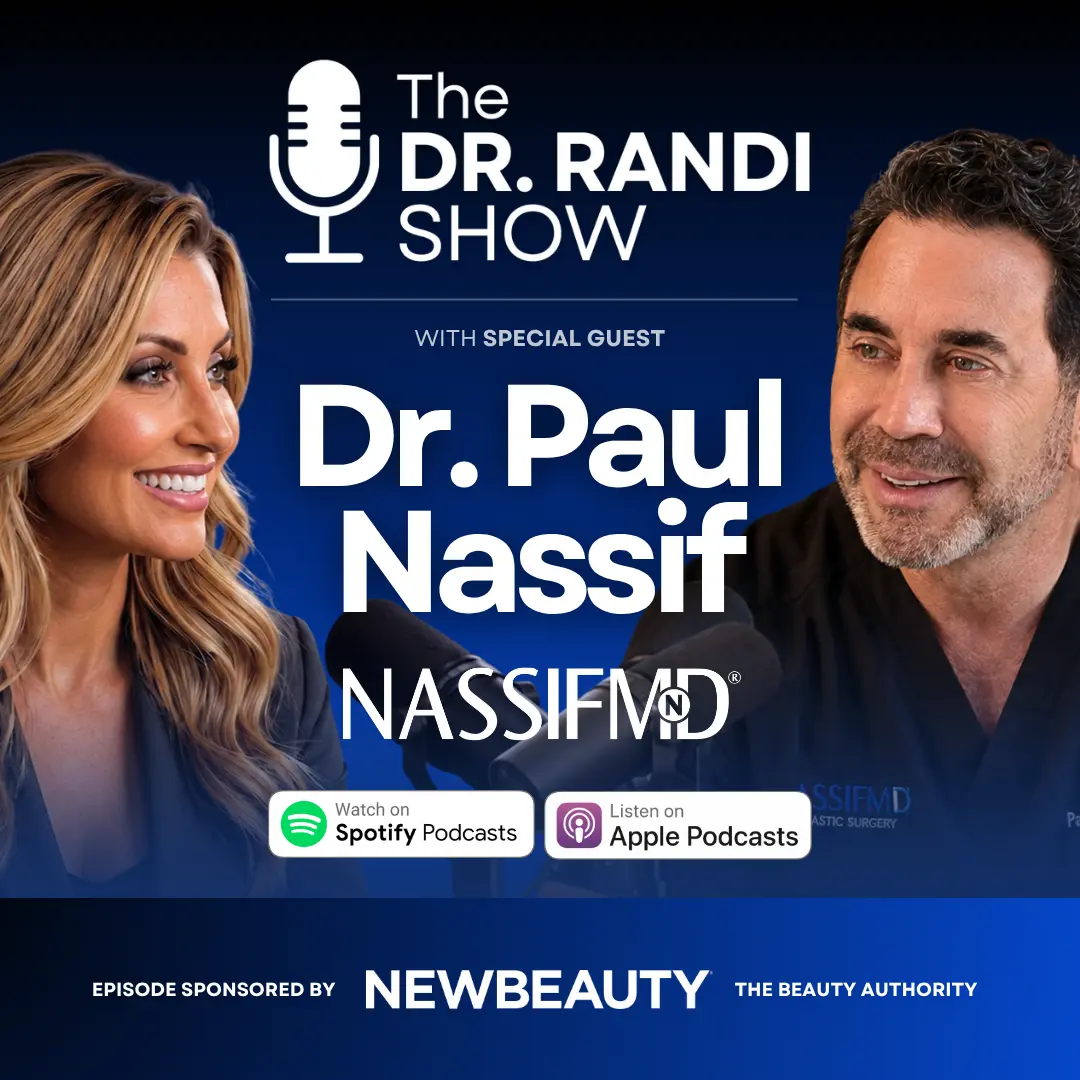
He’s the surgeon behind 13 red-carpet faces at this year’s Oscars, and one of the most talked-about names in aesthetic surgery. In this episode, Dr. Randi sits down with Dr. Sam Rizk, the New York facial plastic surgeon known for transformations so seamless that even HD cameras can’t catch them.
From his sculptor’s precision to his groundbreaking “no-drain” facelift technique, Dr. Rizk has redefined what natural rejuvenation looks like in an era of high-definition beauty. He opens up about the artistry behind every lift, the science of shortening recovery times, and why even the world’s most recognizable faces trust him to make them look untouched.
They dive into:
• The secret to his rapid-recovery facelift technique (no drains, no downtime)
• How he spots “filler fatigue” and decides when it’s time to go under the knife
• Why half of his surgeries are revisions, and what he’s fixing from others
• His philosophy on sharing surgical innovations instead of guarding them
• How art, sculpting, and science intersect in every face he creates
It’s an inside look at Hollywood’s best-kept secret: the surgeon redefining red-carpet beauty, one flawless recovery at a time.
Sponsored by NewBeauty💄
📱 Listen and Watch on Spotify: https://spti.fi/5tvBfDz
🎧 Listen Now on Apple: https://dub.link/oAWiJ9a
Episode FAQ
How do facelift surgeons achieve natural looking results with a faster recovery?
On The Dr. Randi Show, New York plastic surgeon Dr. Sam Rizk, who is also trained as a head and neck surgeon, shared the approach behind what the host described as one of the shortest recovery times in plastic surgery. Dr. Rizk said he performs only one major surgery per day so each case gets his full attention, and he credited a lifelong background in sculpting with shaping how he sees the face as art. He discussed replacing surgical drains with tissue glue, lifting vertically with deep plane technique, creating harmony between the eyes, brow, and face, and why about half of his facelifts are revisions of earlier surgeries. This reflects Dr. Rizk’s clinical experience and is not medical advice.
Can a facelift be done without drains, and how does tissue glue affect bruising and recovery?
On The Dr. Randi Show, Dr. Sam Rizk explained that he stopped using drains in 2005 and began using tissue sealants, which he first learned about as a head and neck surgery fellow at Sloan Kettering, where they were used in cancer surgery. Dr. Rizk said drains can malfunction, can introduce infection, and are uncomfortable, while in his experience tissue glue noticeably reduced bruising. He published an article on tissue glue reducing bruising and the incidence of hematoma in 2008 and said he has since performed about 3,000 facelifts without drains, with patients typically looking less swollen and bruised early on than they expect. Looking ahead, Dr. Rizk said he expects hyperbaric oxygen, lasers, and regenerative medicine to play a growing role in speeding recovery. This reflects Dr. Rizk’s clinical experience and is not medical advice.
Why are people in their late thirties and forties getting facelifts?
On The Dr. Randi Show, Dr. Sam Rizk described two main drivers behind younger facelift patients. First, Dr. Rizk said GLP-1 weight loss medications have caused drastic weight loss in some younger patients, and once the skin and muscle sag, surgery is often the only way to correct it. Second, he pointed to the trend of dissolving filler, explaining that patients who used filler for ten or more years may have stretched skin that does not shrink back once the filler is removed. He stressed that not every young person is a surgical candidate, and said he turns patients away when there is not enough loose skin to justify surgery. This reflects Dr. Rizk’s clinical experience and is not medical advice.
What is filler fatigue, and when is it time to consider a facelift instead of more filler?
On The Dr. Randi Show, Dr. Sam Rizk, who coined the term filler fatigue, explained that many of his patients are referred by dermatologists who have managed them with fillers for years until the fillers can no longer counter the effects of gravity. Dr. Rizk said many of these patients have also tried non-surgical options such as Ultherapy, Sofwave, Thermage, and Ellacor and are now looking for a more meaningful result. He noted that fillers still have a valuable role when used to restore volume rather than to lift, but that trying to lift with filler takes so much product that, over time, both patient and provider can lose track of what the patient used to look like. This reflects Dr. Rizk’s clinical experience and is not medical advice.
How can a facelift look natural instead of pulled or surgical?
On The Dr. Randi Show, Dr. Sam Rizk, whose patients the host noted included 13 people on the 2025 Oscars red carpet, shared the criteria he uses for a natural outcome. Dr. Rizk said the lift should be vertical rather than horizontal, and that going deeper, as in a deep plane facelift, avoids relying on stretching the skin and better protects the skin’s blood supply for a smoother result. He also emphasized facial harmony, explaining that the eyelids, brow, and face should look like they belong in the same age bracket, and that a temporal brow lift may be needed to avoid bunching near the eyes after a vertical lift. This reflects Dr. Rizk’s clinical experience and is not medical advice.
What are the most common reasons people need a revision facelift?
On The Dr. Randi Show, Dr. Sam Rizk said revision facelifts account for about 50 percent of his facelift surgeries. The most common issues Dr. Rizk said he corrects are a lift done in the wrong direction that creates a pulled, fake look; a facelift that fell too quickly because the deeper layers were not addressed; an unaddressed deep volume deficit; and bunching around the eyes when a temporal or partial brow lift was not performed alongside the facelift. His advice was to choose a surgeon who specializes in the face and performs facelifts regularly, which he described as at least three to four per week, rather than an occasional facelift surgeon. This reflects Dr. Rizk’s clinical experience and is not medical advice.
Who is a good candidate for revision rhinoplasty after a disappointing nose job?
On The Dr. Randi Show, Dr. Sam Rizk said the first step in considering revision rhinoplasty is deciding whether the patient’s expectations are realistic. Dr. Rizk explained that a very small, Instagram filtered nose can be a non-functioning nose that makes breathing difficult, so there are limits to what surgery can do. He said issues such as a collapsed or overdone nose, a saddle nose, a scooped nose, breathing problems, or major asymmetries are different and may be improved. He added that revision patients have often been through a difficult experience, so it is important to separate those who could benefit from surgery from those who may be struggling with body dysmorphia. This reflects Dr. Rizk’s clinical experience and is not medical advice.
When should a plastic surgeon turn a patient away from surgery?
On The Dr. Randi Show, Dr. Sam Rizk said he declines about two out of every ten patients, roughly a 20 percent rejection rate, when he feels surgery would not improve their appearance or they are not ready. Dr. Rizk shared the story of a 35 year old patient he declined for a facelift who later had the surgery elsewhere and returned with poor scarring, and of a rhinoplasty patient who traveled from Australia whom he declined because her thick skin would limit the tip result. He said he accepts the occasional bad review from a declined patient because that person would likely be far less happy after a surgery that should not have been done. This reflects Dr. Rizk’s clinical experience and is not medical advice.
What is a shorter scar deep plane facelift, and what new facelift techniques are emerging?
On The Dr. Randi Show, Dr. Sam Rizk said that if he could change one thing about his career, he would have started doing shorter scar facelifts earlier. Dr. Rizk explained that with more of the work done in the deep plane, he now removes less skin and uses a shorter incision in the temple and a smaller incision behind the ear, positioned to support a more vertical lift. He described his newest innovation as a higher entry point into the deep plane, which he demonstrated in a live surgery at the Baker Gordon Symposium, that allows the lift with less cabling of the sutures, which in his view lasts longer and avoids a pulled look. Over roughly 25 years and about 4,000 facelifts and 7,500 rhinoplasties, he said his approach has also evolved toward deeper neck work, more endoscopic brow lifts, and brow fixation devices called Endotines. This reflects Dr. Rizk’s clinical experience and is not medical advice.
How do international patients prepare for plastic surgery in New York?
On The Dr. Randi Show, Dr. Sam Rizk explained that patients travel to his practice from the Middle East, Europe, South America, and beyond. Dr. Rizk said his nursing team corresponds with patients before they arrive through FaceTime, and coordinates required pre-operative steps such as blood work and a Schirmer’s test before eyelid surgery, while he also consults with patients by FaceTime or Zoom. He always examines patients in person the day before surgery, which he described as very important because it allows him to confirm the plan or decide to add or remove a procedure. This reflects Dr. Rizk’s clinical experience and is not medical advice.