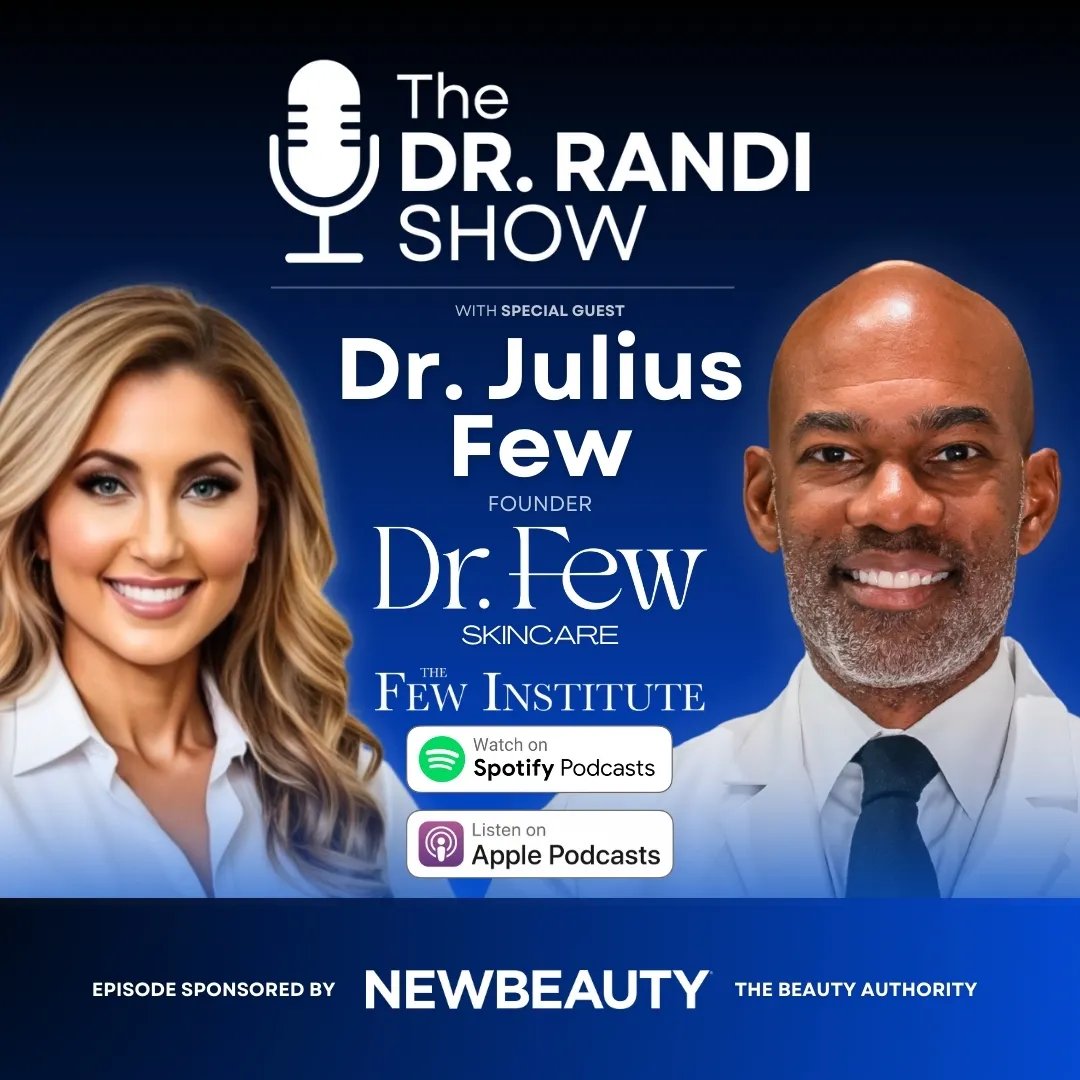
What do Gwyneth Paltrow and GLP-1 users have in common? They both turn to Dr. Julius Few, MD when skin health is on the line.
In this episode, Dr. Randi Boyette sits down with the world-renowned plastic surgeon and researcher who created the first clinically proven skincare line designed for the unique aging challenges caused by GLP-1 medications like Ozempic and Wegovy. Rapid weight loss can mean rapid changes — skin laxity, thinning, pigmentation shifts — and most skincare simply can’t keep up. Dr. Few’s peptide-powered Derma Reverse is changing that.
They break down:
• Why GLP-1 weight loss can speed up visible aging
• The science behind reversing “GLP-1 face”
• How regenerative skincare is replacing overfilled, overdone looks
• The product development process that even influenced Goop’s cult-favorite Youth Boost Serum
• Why AI, integrity, and personalization are the next frontier in aesthetics
From celebrity beauty secrets to hard science, this episode blends insider access with practical takeaways — giving you a front-row seat to the future of skin health.
This episode is sponsored by: NewBeauty💄
🎧Listen Now on Apple: https://dub.sh/RPh80Be
📱 Listen and Watch here on Spotify: https://spti.fi/ulq6JTE
Episode FAQ
How are GLP-1 weight loss medications affecting skin, and how is science-backed skincare responding?
On The Dr. Randi Show, Dr. Julius Few, a board certified plastic surgeon with nearly 26 years in practice, shared how he began noticing distinctly different skin changes in facelift and facial cosmetic surgery patients who were using GLP-1 medications. That observation led him to start clinical research, about two and a half to three years ago, into what was happening to the skin at a cellular level, and ultimately to develop DermaReverse, a product in his Dr. Few Skincare line designed for GLP-1 users. He emphasized that his approach is to test products in controlled clinical studies and publish the results for peer review, and said his skincare philosophy centers on helping the skin work better rather than stripping it. He also discussed common skincare myths, where he sees aesthetics heading, and his skincare collaboration with Gwyneth Paltrow for goop. This reflects Dr. Few’s personal and professional experience and is not medical advice.
Do GLP-1 medications change the skin itself, or is it just the weight loss?
On The Dr. Randi Show, Dr. Julius Few said he believes the look many people notice on GLP-1 medications comes from multiple factors. In many cases there is significant weight loss, but he said there also appears to be a tangible change to the skin itself, describing skin that seems to thin out and lose elasticity in as little as three months. He said his team’s biopsy (histology) data supported this, and that his study published in the Aesthetic Surgery Journal was, in his view, the first of its kind to describe a direct skin change alongside a placebo controlled, double blinded study of a topical solution. This reflects Dr. Few’s clinical and research experience and is not medical advice.
What is DermaReverse, and how quickly might results appear?
On The Dr. Randi Show, Dr. Julius Few described DermaReverse as a product he developed by reverse engineering the problem, first studying the likely cause of GLP-1 related skin changes and then looking to the science for a plausible solution. He said that in his controlled clinical study, where participants did not know whether they received a placebo or the active product, results were seen as early as one week, with what he called dramatic results at six weeks, and that side by side photos showed a clear difference. He also described it as a retinoid that can be used both morning and night, noting that many retinoids typically make skin more sensitive to the sun. Individual results vary. This reflects Dr. Few’s clinical research experience and is not medical advice.
Can skincare help with dullness, uneven pigmentation, or melasma related to GLP-1 use?
On The Dr. Randi Show, Dr. Julius Few said patients who have used DermaReverse while on GLP-1 medications, currently or in the past, have reported skin that looks more toned, lifted, and less dull. He shared that a handful of his patients also began using it on their own for melasma and that he has seen some impressive results in that group, which he described as patient experience rather than a studied outcome. He explained that his study suggested GLP-1 medications may turn off the skin’s natural sun protective factor, which he believes may be why some users, even younger ones, notice dullness or pigmentation changes, and he said he believes the product helps the skin protect itself better. This reflects Dr. Few’s clinical observations and is not medical advice.
How can patient feedback shape new skincare products, like a clean retinol or a daytime eye serum with SPF?
On The Dr. Randi Show, Dr. Julius Few, who still actively performs surgical and nonsurgical treatments, explained that his Dr. Few Skincare line of 12 products is driven by what his patients say they wish existed. He described regularly asking a core group of about 20 patients what they would want in their wildest dreams, then working backward, with one to two new products in testing at any given time. He said this approach led to what he described as the first clean retinol and a daytime eye serum with SPF, which he said he personally uses for under eye hyperpigmentation that runs in his family. He also shared that the products helped his two sons with typical adolescent acne, and said he considers the line suitable for a wide range of people. This reflects Dr. Few’s personal and professional experience and is not medical advice.
Is it worth taking a GLP-1 medication to lose just a few pounds?
On The Dr. Randi Show, Dr. Julius Few offered what he called a cautionary tale for anyone on the fence about starting a GLP-1 medication to lose five or six pounds. In his view, there is a trade off, because the medication can affect the skin directly whether someone is looking to lose five pounds or 50. He said this is an especially important consideration for older adults, whose skin is already thinner with age, and suggested it may not be worth it for a small amount of weight. For those who do use these medications, he pointed to supportive skincare as a way to help. Anyone considering a GLP-1 medication should discuss the risks and benefits with their own physician. This reflects Dr. Few’s professional perspective and is not medical advice.
Is it bad to over-wash your face or use harsh exfoliants?
On The Dr. Randi Show, Dr. Julius Few said the biggest skincare myth he consistently debunks is the idea that you need to strip or break down the skin to get good results, such as with harsh toners or medicated wipes. He explained that the skin’s natural oils are among its most powerful anti-aging components and that products should add what the skin needs rather than replace it, comparing good skincare to good nutrition. He shared the example of a patient who washed her face four times a day and described her skin as very sensitive, which he attributed to stripping away the skin’s ability to manage itself. He said gentle mechanical exfoliation, like using a washcloth, does not need to happen several times a day, and that some people, especially in colder months, may only need to wash at night. This reflects Dr. Few’s clinical experience and is not medical advice.
Is there a skin tightening product for the body that also includes sunscreen?
On The Dr. Randi Show, Dr. Julius Few previewed a body product his team was soft launching, which he referred to as Body Tight, designed to give skin an immediately smoother, tighter look while also including sun protection. He said the idea came from patients who wanted their skin to look its best in warmer months, for example on areas like the inner arm when wearing a swimsuit or a backless dress. He noted that his team typically releases new products to his own patients first, and that this one sold out in two days in that internal launch. He added that he sees even people in their 30s bothered by inner arm skin, and that he values skincare as a noninvasive option that does not require a procedure. This reflects Dr. Few’s professional experience and is not medical advice.
What is the next big innovation in aesthetics, and how could AI change cosmetic treatments?
On The Dr. Randi Show, Dr. Julius Few, who has practiced since before Botox was widely used, predicted a shift toward truly individualized aesthetics, driven in part by artificial intelligence. He said he co-authored what he believes may be the first published article worldwide on AI and aesthetic perceptions. While he noted his own concerns about AI, he said he sees one clear positive: tools that can help people understand what they can do without looking unnatural. He explained that fear of looking strange is the number one barrier to cosmetic treatment, and that in his estimate only about 10 percent or less of the US population has these treatments. He expects the era of overdone results, like too much filler, to fade in favor of what he calls the aesthetic version of quiet luxury, and stressed choosing a reputable provider with integrity who will tell you when you do not need more. This reflects Dr. Few’s professional perspective and is not medical advice.
What is the goop Youth-Boost Peptide Serum, and how was it developed?
On The Dr. Randi Show, Dr. Julius Few shared that he co-created the goop Youth-Boost Peptide Serum with Gwyneth Paltrow, whom he described as a dear friend of more than a decade and a very hands-on entrepreneur. He said she approached him to develop a product together knowing his background in biochemistry, and that they collaborated closely with her team. He described it as the first peptide based serum to be clinically tested and published, designed around supplying cofactors that help the skin repair and heal itself, and said it has won several awards and may still be among goop’s top selling products. He noted that he still offers it in his office. This reflects Dr. Few’s personal and professional experience and is not medical advice.