The facelift is having one of its biggest moments in decades, and the standard has never been higher. Patients want meaningful results without losing the features that make them look like themselves.
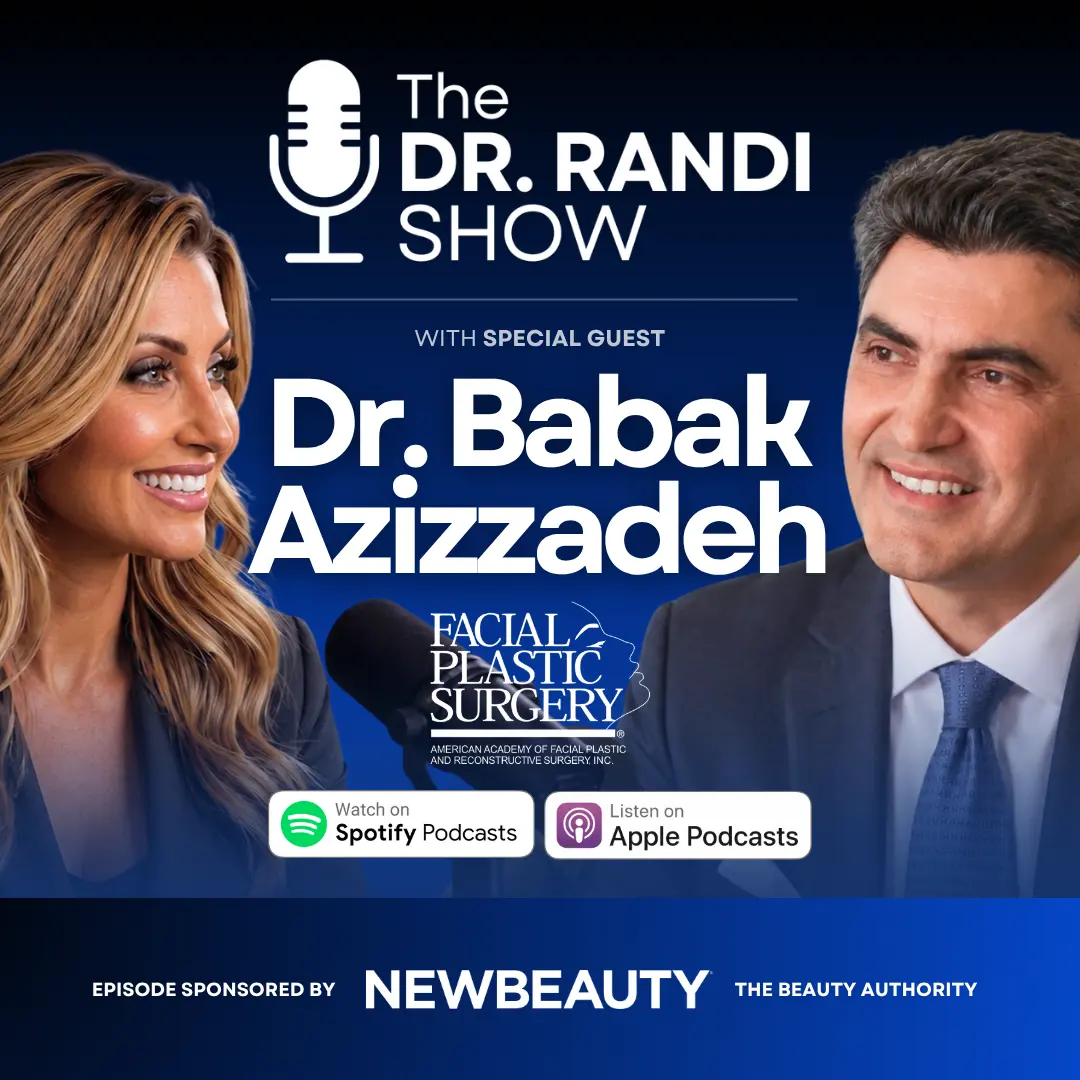
In this episode of The Dr. Randi Show, Dr. Randi Boyette sits down with Dr. Babak Azizzadeh, one of the most influential names in facial plastic surgery. For more than two decades, he has focused exclusively on the face, earning an international reputation for deep-plane facelifts and some of the most challenging revision cases. He is also the president-elect of the American Academy of Facial Plastic and Reconstructive Surgery.
Dr. Azizzadeh explains what is driving the facelift’s return, what truly separates a deep-plane facelift from other techniques, and why the surgeon’s aesthetic eye is just as important as technical skill. He also reveals what makes revision surgery so complex, why the price of a facelift can vary by hundreds of thousands of dollars, and what patients should investigate before trusting a surgeon with their face.
They discuss:
- Deep-plane versus traditional facelift techniques
- How the best results preserve a patient’s identity
- Finding the right time to consider surgery
- Why facelift pricing varies so dramatically
- AI and the future of facial plastic surgery
- The treatments Dr. Azizzadeh rates a 10 and the ones he gives a zero
From $300,000 facelifts to the treatments that may not live up to the hype, Dr. Azizzadeh does not hold back. This episode gives patients a rare look at the artistry and surgical expertise behind results that can turn back the clock while still looking completely authentic.
Sponsored by NewBeauty 💄
📱 Listen and Watch on Spotify: https://dub.sh/VT7GC9n
🎧 Listen Now on Apple: https://dub.sh/KMguXrE
Episode FAQ
What should patients know about facelifts, revision surgery, and choosing a facial plastic surgeon today?
On The Dr. Randi Show, Dr. Babak Azizzadeh, a double board certified facial plastic surgeon with more than two decades of operating exclusively on the face and the president elect of the American Academy of Facial Plastic and Reconstructive Surgery, shared his perspective on the aging face. He discussed why facelifts are having a resurgence, how the deep plane facelift differs from the SMAS technique, why facelift prices vary so widely, what causes an overdone or pulled look, and why revision facelifts are more complex. He also explained what board certification means, when non-surgical treatments reach their limit, and how he expects AI to change the way patients find and work with surgeons. This reflects Dr. Azizzadeh’s personal and professional experience and is not medical advice.
Why are facelifts making a comeback?
On The Dr. Randi Show, Dr. Azizzadeh said that over roughly the past five years he has seen many people revisit their goals, moving away from holding off on surgery as long as possible. He pointed to the post COVID surge in plastic surgery interest, social media, and the visibility of results, noting that people generally look great after a well performed facelift. He also named two other driving forces he has observed: the Ozempic face phenomenon tied to GLP-1 weight loss medications, and a filler fatigue trend among people who felt their filler had been overdone. He was clear that surgery carries more risk and more cost than non-surgical options, but in his view it can be very meaningful for the right person. This reflects Dr. Azizzadeh’s clinical experience and is not medical advice.
Is there a right age to get a facelift, and should you get one early to prevent aging?
On The Dr. Randi Show, Dr. Azizzadeh said he supports being proactive, but he does not believe in getting a facelift simply to keep looking great when you already do. In his view every treatment should be done at the right time, with the right intent, and by the right surgeon, and there is a sweet spot that is different for everyone depending on anatomy, genetics, ethnicity, and how a person ages. He noted that some people with features such as a heavy neck, a small chin, or a heavy lower face may benefit from surgery earlier, perhaps in their 40s rather than their 50s. This reflects Dr. Azizzadeh’s clinical experience and is not medical advice.
What is a deep plane facelift, and how is it different from a SMAS facelift?
On The Dr. Randi Show, Dr. Azizzadeh explained that the deep plane facelift is a real and distinct operation from the SMAS facelift, and that he performed SMAS facelifts for the first half of his career before switching to the deep plane technique for the last 10 to 12 years. He described the deep plane approach as separating the correct anatomic layers and repositioning them rather than pulling skin, and said that in his hands it gives more natural, authentic results. He acknowledged that the term is also used heavily in marketing, and cautioned that surgeons who are not comfortable with the technique should not perform it, since it works at a different tissue layer closer to the facial nerves. This reflects Dr. Azizzadeh’s clinical experience and is not medical advice.
Why do deep plane facelift prices range from $30,000 to $300,000?
On The Dr. Randi Show, Dr. Azizzadeh explained that surgery is not a true commodity. Unlike comparing a luxury handbag to a less expensive one, no two surgeons or surgeries are the same, and pricing reflects each surgeon’s experience, expertise, aesthetic taste, safety profile, and how they manage complications. He said a $30,000 facelift can be excellent and a far more expensive one can occasionally fall short, so price alone does not determine quality. His advice was to do your homework: confirm the surgeon’s experience and track record, and make sure you love their results and how they care for patients. This reflects Dr. Azizzadeh’s professional experience and is not medical or financial advice.
What makes a facelift look overdone or pulled, and how do you get natural results?
On The Dr. Randi Show, Dr. Azizzadeh said a pulled or overdone look is generally the result of poor surgical technique with the wrong vector, or direction, of repositioning, such as pulling too high or too far back, and it can also follow repeated surgeries. He noted it can come from the surgeon’s aesthetic taste, the patient’s own request, or both. For natural results, he asks patients to think about the era of their life when they felt they looked their best, and aims to help them feel that way again, which he describes as revealing their authentic self. He added that two highly skilled surgeons can still produce different looks, so reviewing a surgeon’s before and after photos matters. This reflects Dr. Azizzadeh’s clinical experience and is not medical advice.
Why do people need a revision facelift, and why is revision surgery more difficult?
On The Dr. Randi Show, Dr. Azizzadeh described three main groups of patients seeking another facelift. Many were happy with a facelift eight to 12 years earlier and simply want another, which he calls a secondary facelift. Others had a recent facelift that sagged sooner than expected or did not look quite right, and a smaller group experienced complications such as an unresolved nerve injury or an incorrect vector of pull. He explained that revision surgery is significantly harder because scar tissue is always present after a prior surgery and the facial nerve anatomy is less predictable, which is why he uses nerve monitors and nerve stimulators for almost all of his revision facelifts. This reflects Dr. Azizzadeh’s clinical experience and is not medical advice.
What does board certified mean in aesthetics, and how is a facial plastic surgeon different from a plastic surgeon?
On The Dr. Randi Show, Dr. Azizzadeh described board certification as a stamp of approval from peers confirming that a physician has the training to perform a particular surgery. He outlined the core aesthetic specialties: facial plastic surgeons certified by the American Board of Facial Plastic and Reconstructive Surgery, who train in head and neck surgery or plastic surgery and focus only on the face, neck, eyes, and nose; plastic surgeons certified by the American Board of Plastic Surgery, who train across the whole body; dermatologists, who focus on non-surgical aesthetics and skin cancer; and oculoplastic surgeons, who focus on the eyes, brows, and cheeks. His advice was to look beyond the credential and ask what a surgeon’s niche is, choosing someone whose experience matches the procedure you want. This reflects Dr. Azizzadeh’s professional experience and is not medical advice.
How do you know when fillers and non-surgical treatments are no longer enough?
On The Dr. Randi Show, Dr. Azizzadeh said there is a point of diminishing returns with many non-surgical treatments, and that people can lose sight of how they look to others once they start getting filler. He said it often takes a good friend, a family member, or a good surgeon to say it is time to slow down, and that a great doctor should keep patients in check with ethics and integrity. He noted that Botox is an exception in his view, since it keeps working and can benefit people from young to old, while other devices and treatments have a strong role when used with restraint. This reflects Dr. Azizzadeh’s clinical experience and is not medical advice.
Which aesthetic treatments are worth it, according to a facial plastic surgeon’s speed round ratings?
In a rapid fire segment on The Dr. Randi Show, Dr. Azizzadeh rated treatments from one (overrated) to 10 (absolutely worth it) based on his personal opinion. He gave a 10 to medical grade skincare, baby Botox, neck band neuromodulator treatment, and chin implants, and a 10 to CO2 laser resurfacing and masseter neuromodulators for facial slimming when appropriate for the patient. He rated temple filler a nine, facial fat grafting and hyperbaric oxygen for surgical recovery an eight, and biostimulators and lip lifts a seven. Lower ratings included tear trough filler at five, PRP at five to six, micro-coring and chemical peels at four to five, AI surgical simulations at four to five with potential to rise, preventative neuromodulators at three, liquid rhinoplasty at two, at home skin tightening devices at one to two, and thread lifts at zero. He said the jury is still out on exosomes because not enough is known yet. These ratings reflect Dr. Azizzadeh’s personal opinion and are not medical advice.