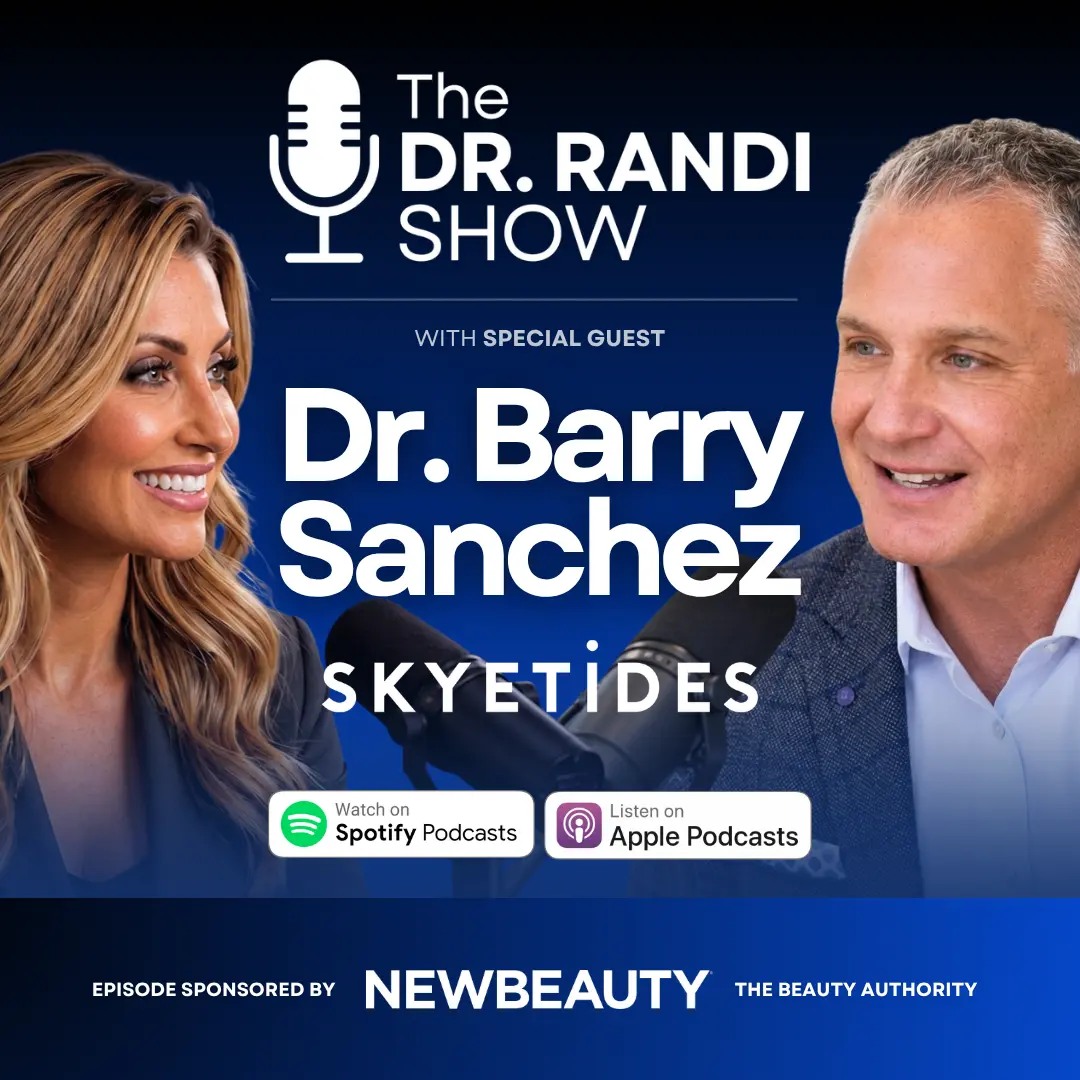
He helped turn HydraFacial into a household name, launched OrangeTwist to reinvent the consumer experience of aesthetics, and now, through greyspace, is shaping the next evolution of beauty, health, and longevity.
This week, Dr. Randi Boyette sits down with Clint Carnell, a visionary founder and category architect whose influence has redefined how people experience medical aesthetics. Together, they unpack the shifts transforming the industry: from the rise of GLP-1s and longevity medicine to the merging of in-clinic and at-home innovation.
What follows is a candid, forward-looking conversation about how the aesthetic landscape is evolving, and what smart clinics, entrepreneurs, and consumers should do to stay ahead.
🔹 Why aesthetics is still in its early innings, and what that means for growth
🔹 GLP-1s as a catalyst, not a competitor, to the aesthetic journey
🔹 Skin tightening’s science gap, where progress is real and where proof still lags
🔹 The surge in hair restoration, and how it’s finally become a co-ed category
🔹 The “and, not or” mindset: bridging professional care with medical-grade at-home tools
🔹 Exosomes & peptides: the data, the hype, and what’s next
🔹 AI’s real role: augmentation, not automation
🔹 Smarter business models that educate patients and elevate access
Clint’s insight is clear: the future of aesthetics belongs to those who fuse beauty with health, technology with education, and credibility with aspiration.
If you want a roadmap for where the beauty and longevity industries are truly heading, from a leader who’s built category-defining brands and is building what’s next, this episode is it.
Sponsored by NewBeauty💄
📱 Listen and Watch on Spotify: https://spti.fi/XcLXIBL
🎧 Listen Now on Apple: https://dub.sh/V6ViD5Q
Episode FAQ
What does The Dr. Randi Show episode on the future of medical aesthetics cover?
In this episode of The Dr. Randi Show, host Dr. Randi Boyette sat down with Clint Carnell, the executive credited with turning HydraFacial into a global brand and launching OrangeTwist, to talk about where medical aesthetics is headed. Reflecting on about 20 years in the industry, Clint Carnell shared his views on industry growth, the impact of GLP-1 medications, changing patient expectations, regenerative treatments like exosomes and peptides, at-home devices, AI, and the coming together of aesthetics, wellness, and longevity. The answers below reflect his personal opinions and industry experience and are not medical advice.
Is the medical aesthetics industry still growing, or is it slowing down?
On The Dr. Randi Show, Clint Carnell said he believes medical aesthetics is still in its “early innings.” He acknowledged that the industry has gone through periods when consumer spending slows, and that some more commoditized product lines are maturing, but said growth in the low double digits is still remarkable compared with most businesses. In his view, growth is being driven by new consumers entering the category, including younger people, more men, more people of color, and less affluent consumers, and by aesthetics increasingly being seen as part of a healthy lifestyle alongside diet and exercise. This reflects his personal perspective and is not financial or medical advice.
How have GLP-1 weight loss medications changed the aesthetics industry?
Speaking on The Dr. Randi Show, Clint Carnell called GLP-1 medications a game changer and said they would be his headline for aesthetics in 2025. He explained that as people start to feel better about their weight, many naturally look for treatments that help them feel as good on the outside as they do on the inside. He said OrangeTwist has seen success with GLP-1 programs, and that having an aesthetic provider alongside someone during a medical weight loss journey can be meaningful for health and safety and as a guide to next steps. He also pointed to skin tightening for loose or crepey skin after rapid weight loss as a problem he hopes skincare brands will solve. This reflects his personal perspective and is not medical advice.
How have patient expectations and demographics for aesthetic treatments changed?
On The Dr. Randi Show, Clint Carnell said that from roughly 2005 to 2012, aesthetic treatments were often seen as fixing something, and people who got them were sometimes judged as shallow. Over the last decade or so, he said, patients have become far better educated, arrive knowing what treatments they want, and aim to enhance what they already like about themselves. He noted that most patients come in for a reason, such as a wedding, a reunion, or weight loss, and that preferences can vary by region. From his time leading HydraFacial, he shared that its customers turned out to be younger, more male, less affluent, and more diverse than the traditional industry profile assumed. This reflects his personal experience and is not medical advice.
What is the aesthetics industry still getting wrong, and why is skin tightening so hard to deliver?
On The Dr. Randi Show, Clint Carnell said the industry, especially manufacturers, still needs to explain what products and services do in clearer terms, describing the current landscape as “alphabet soup” that can confuse consumers. He named skin tightening as a category that remains elusive, whether through ultrasound, RF, microneedling, or laser treatments, because results take time, are hard to measure, and often come down to subjective before-and-after comparisons. He also cautioned against overpromising, saying it hurts the whole industry when products underdeliver. This reflects his personal opinion and is not medical advice.
Are exosomes, peptides, and hair growth treatments the next big thing in regenerative aesthetics?
Clint Carnell told The Dr. Randi Show that he likes exosomes and peptides and believes they are here to stay, but said it is still hard to tell which factors make one product better than another, comparing the moment to the early days of lasers. He expects peptides to face closer scrutiny that will separate strong products from weaker ones, and he hopes the industry handles the category responsibly. He called hair growth and hair strengthening especially interesting, noting it should always have been a female-focused category, and said HydraFacial launched its Keravive scalp treatment just before the pandemic, perhaps a little early. This reflects his personal perspective and is not medical advice.
Will at-home beauty devices replace in-office aesthetic treatments?
On The Dr. Randi Show, Clint Carnell said at-home care and in-office treatments are not an either-or choice, and he believes both have a role. He compared it to dental care: brushing and flossing at home does not replace regular visits to the dentist. He cited data his team once commissioned showing that nine out of ten patients left their provider’s office without buying medical-grade skincare, and said many practices still earn less than 5% of revenue from skincare. He cautioned manufacturers against making at-home devices too powerful to use without professional supervision, and said products should match an appropriate price point, efficacy, and safety profile. This reflects his personal opinion and is not medical advice.
How often should you get a HydraFacial, and how can aesthetic treatments fit into an ongoing routine?
On The Dr. Randi Show, Clint Carnell described aesthetic care as a continuum rather than a series of one-off treatments. Speaking generally, he said he often tells people a HydraFacial once a month is great if time and budget allow, but quarterly works for most, paired with good medical-grade skincare, possibly red light therapy in between, and a neurotoxin about every four months. He added that filler should start with a conversation with a provider about goals, and mentioned options like Clear + Brilliant, RF once or twice a year, and microneedling or fractional technology as part of an ongoing plan. He also shared that he keeps his own daily skincare routine to about three steps. Treatment plans should be personalized with a qualified provider, and this reflects his personal opinion, not medical advice.
How will AI be used in medical aesthetics?
Clint Carnell told The Dr. Randi Show that AI could become a personal beauty guide that helps consumers work with their provider, for example by showing how someone might age with or without treatments and suggesting a sequence of options to discuss. He also described AI putting an expert’s knowledge directly in a sales rep’s ear, and said OrangeTwist uses AI to speed up its marketing campaigns. He cautioned against making AI gimmicky and said he believes it will augment human performance rather than replace people, making creative thinking even more valuable. This reflects his personal perspective.
What will the aesthetics industry look like in five years, and how does longevity fit in?
On The Dr. Randi Show, Clint Carnell predicted that the next five years will bring more choice in a space once dominated by Botox, with more toxins and fillers entering the US market, commoditization of energy devices, and a growing focus on skincare. He expects globalization, with engineers in China, Korea, and Eastern Europe building strong products at lower cost, to make treatments more accessible worldwide, along with continued growth of medical spas and new business models that bring prices down. He also sees aesthetics converging with health, wellness, and longevity, pointing to concierge medicine, regular blood panel work, and destination wellness concepts like Canyon Ranch, while noting that simple habits like friendship and self-care matter too. This reflects his personal opinion and is not medical or financial advice.