He built the biggest vitality and wellness empire in America, and he’s just getting started.
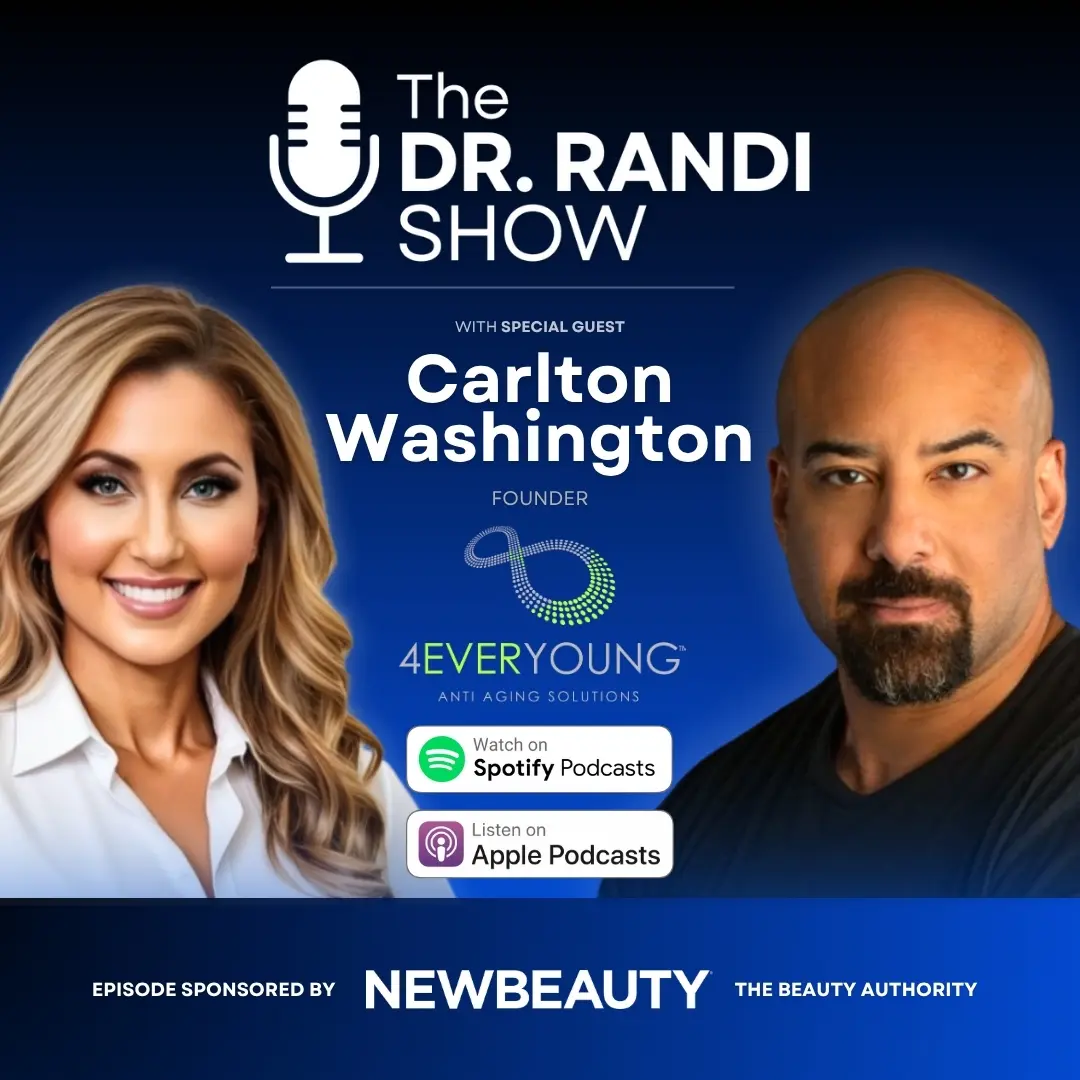
In this episode, Dr. Randi Boyette sits down with Carlton Washington, co-founder of 4Ever Young Anti-Aging Solutions to explore how peptides, NAD, and longevity medicine are reshaping the future of health and aesthetics. From GLP-1 weight loss to cellular optimization, Carlton shares the science, the strategy, and the self-experimentation that turned his passion into a nationwide movement.
They break down:
• How GLP-1s started a movement, and what’s coming next in the evolution of weight loss and performance
• Why NAD has become the go-to treatment for energy, recovery, and mental clarity
• Peptides that go beyond weight loss, from BPC-157 “the Wolverine peptide” to Tesamorelin for visceral fat
• The rise of MOTS-C and other next-gen mitochondrial peptides
• Why consistency, not quick fixes, is the real secret to vitality and longevity
From anti-aging to biohacking, this episode dives deep into the tools and mindset driving the wellness revolution, and what it really takes to stay limitless.
Sponsored by NewBeauty💄
📱 Listen and Watch on Spotify: https://spti.fi/6tZqfxZ
🎧 Listen Now on Apple: https://dub.sh/ezIRrCA
Episode FAQ
What did the October 2025 episode of The Dr. Randi Show cover about peptides and NAD+?
In this October 2025 episode of The Dr. Randi Show, host Dr. Randi Boyette welcomed back Carlton Washington, co-founder of the 4Ever Young wellness and vitality med spa chain, which he said has grown to more than 65 locations in about 24 states. Carlton Washington described himself as a former banker turned wellness entrepreneur who tries therapies on himself first, and he was clear that he is not a doctor or scientist. The conversation covered GLP-1 weight loss medications, NAD+ therapy, popular peptides such as BPC-157, tesamorelin, and CJC-1295 with Ipamorelin, and who is driving demand for wellness treatments. The answers below reflect his personal experience and opinions and are not medical advice.
Are GLP-1 weight loss medications meant to be used long term, and what weight loss peptide is coming next?
On The Dr. Randi Show, Carlton Washington explained that GLP-1 medications are synthetic peptides that, in his words, do not burn fat but signal the body that it is full or has enough nutrients, prompting it to draw on stored energy. He said they have helped many people, including staff members and patients at his clinics, lose significant weight, but he views them as a way to jumpstart a healthier lifestyle rather than a lifelong solution. For the average person, he said he would favor microdosing over building a long-term reliance, paired with exercise and healthier choices. Looking ahead, he expressed interest in MOTS-c, a mitochondrial peptide he said is being described as “exercise in a shot” that may help reset metabolism, while noting his clinics did not yet offer it and he had not tried it. This reflects his personal perspective and is not medical advice.
Do peptide injections hurt?
Carlton Washington said on The Dr. Randi Show that fear of needles is one of the biggest barriers keeping people from trying peptides and GLP-1 medications. In his experience, the small needles used for subcutaneous peptide injections go into the fat beneath the skin, and he said the only real sensation is at the skin’s surface. He encouraged listeners to “pick your needles,” meaning that choosing a small preventive injection now may be preferable to the needles someone else might choose for you in a hospital later. This reflects his personal opinion and is not medical advice.
What is NAD+, and is it a peptide?
On The Dr. Randi Show, Carlton Washington explained that NAD+ is not a peptide. He described it as a master coenzyme, while peptides are short chains of amino acids that send signals telling the body what to do. In layman’s terms, he compared NAD+ to taking a body whose battery is half charged and fully recharging it, affecting both mental sharpness and energy in what he called a clean, focused way rather than a stimulant feeling. He noted that his explanations come from his own experience and patient feedback, not from a medical or scientific background. This reflects his personal perspective and is not medical advice.
What does an NAD+ IV feel like, and what side effects can it cause?
Carlton Washington shared on The Dr. Randi Show that his first NAD+ IV came after a difficult bout of COVID-19, about 30 days before a boxing match he had been training for. He said he received roughly 750 to 1,000 milligrams of NAD+ and described feeling sharper and more energized, comparing it to the movie Limitless, and he reported losing about 15 pounds during that period, which was his individual experience. He said many people, especially men, feel flushing and palpitations during the infusion, which is why it is diluted and given slowly over about three hours rather than pushed. He also admitted that he had a bad reaction twice when he tried to force it in faster with a pressurized pump against instructions, and he stressed that NAD+ should be done slowly. This reflects his personal experience and is not medical advice.
How often should you get an NAD+ IV, how much does it cost, and do oral NAD+ supplements work?
On The Dr. Randi Show, Carlton Washington described the IV as a loading dose that charges the battery, which can then be maintained with subcutaneous injections, nasal spray, or intramuscular injections. His personal suggestion for budget-conscious patients was a large loading IV about quarterly, with subcutaneous injections five days on and two days off, while those less concerned with cost might do a loading IV monthly plus a morning nasal spray or injection. He estimated an NAD+ IV typically runs about $500 to $750, and possibly $1,000 to $1,200 at clinics positioned as elite, and advised choosing a provider you trust. He was blunt that, in his view, oral NAD+ supplements do not deliver the benefit. He noted he is not a doctor, so this reflects his personal opinion and is not medical advice.
What is BPC-157, and why is it called the Wolverine peptide?
Carlton Washington described BPC-157 on The Dr. Randi Show as a popular recovery peptide that became well known in the fitness and bodybuilding communities for helping repair tissue and heal injuries faster. He said it has been nicknamed the “Wolverine” peptide, after the X-Men character known for rapid healing. He shared that he was personally taking it nightly while healing from some issues of his own at the time of recording. This reflects his personal experience and opinion and is not medical advice.
What is tesamorelin, and how does it compare with AOD-9604 for fat loss?
On The Dr. Randi Show, Carlton Washington called tesamorelin the most impressive peptide he has seen offered. He explained that it was originally developed to help people with HIV reduce the stored and visceral fat that can build up with certain medications, and said it works by increasing IGF-1 to target fat rather than muscle. He said patients at his clinics often come back thrilled with their body composition changes, and shared that his own results come from combining tesamorelin about five days a week with TRT (testosterone replacement therapy), regular exercise, and eating clean about 70 percent of the time. By contrast, he said he personally tried AOD-9604 and was not impressed with it for fat loss. This reflects his personal experience and is not medical advice.
What are CJC-1295 and Ipamorelin, and do they have side effects?
Carlton Washington explained on The Dr. Randi Show that CJC-1295 and Ipamorelin are often combined as a stack of growth hormone stimulating peptides, with Ipamorelin viewed as a step up from Sermorelin, which he said was once the most popular peptide in the anti-aging space. He said the combination is used to help with stored fat, sleep, hair, skin, and nails, recovery, and preserving muscle, and noted that regulatory restrictions have made it harder to get. On side effects, he said some people experience palpitations or a racing heartbeat after an injection, which he believes is linked to the CJC-1295 component, and shared that a family member had that reaction while he never has. This reflects his personal experience and is not medical advice.
Who is seeking out peptides and wellness therapies, and why hasn’t NAD+ gone mainstream?
On The Dr. Randi Show, Carlton Washington said interest in peptides is growing, especially among younger people, but education remains the biggest missing piece. He observed that women, who he feels tend to research more and be more purposeful, are now leading much of the demand for hormones and peptides, a shift from when men drove the market. He estimated that only around 8 percent of his patients had tried NAD+, and said he does not expect it to become as mainstream as weight loss medications, partly because of cost but mainly because results depend on consistency, routine, and discipline. These are his personal observations and are not medical advice.