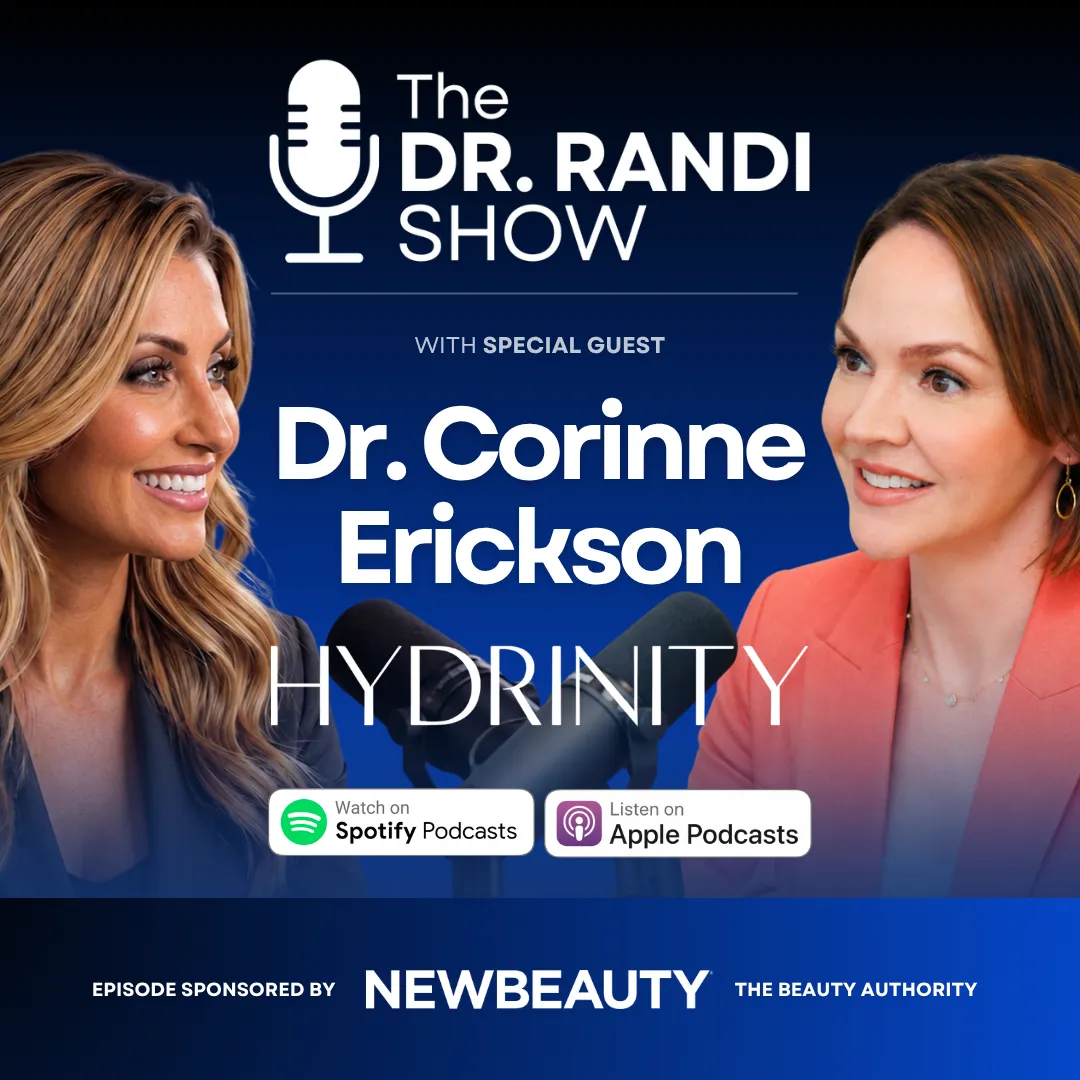
On this episode of The Dr. Randi Show, Dr. Randi Boyette sits down with Corinne Erickson, MD, FAAD, board-certified dermatologist and menopause society-certified practitioner, for a conversation about skin health, aging, hormones, and the science behind one of the most talked-about skincare brands in dermatology today: HYDRINITY.
Dr. Erickson breaks down the biological changes that impact skin over time and explains why hydration, barrier function, collagen production, and inflammation play such an important role in maintaining healthy skin at every age.
The conversation also takes a deep dive into HYDRINITY and the technology behind the brand’s rapid rise among dermatologists, aesthetic providers, and skincare enthusiasts. Dr. Erickson shares why HYDRINITY has become a staple in her practice, the products she recommends most often, and how innovations in hyaluronic acid, antioxidants, peptides, retinal technology, and regenerative skincare are helping improve overall skin quality.
You’ll also get a closer look at some of Hydrinity’s most popular products, including Restorative HA Serum, Hydra-C, Eye Renew, and RetaXome, and learn how each product is designed to support hydration, barrier repair, antioxidant protection, collagen renewal, and healthier-looking skin.
In this episode, they discuss:
🔵Why skin can suddenly become dry, dull, sensitive, or acne-prone
🔵The relationship between hormones, hydration, and collagen loss
🔵The science behind Hydrinity’s approach to hydration and barrier repair
🔵Why hyaluronic acid is far more than a simple hydrator
🔵Dr. Erickson’s Hydrinity regimen and favorite products
🔵RetaXome and the evolution of retinal technology
Whether you’re navigating changing skin, searching for better skincare solutions, or simply curious about the science behind healthy skin, this episode offers expert insights, practical advice, and a compelling look at the innovations shaping the future of skincare.
Sponsored by NewBeauty💄
📱 Listen and Watch on Spotify: https://spti.fi/4wBzH2C
🎧 Listen Now on Apple: https://dub.sh/vDlGMWh
Episode FAQ
How do perimenopause and menopause change your skin?
On The Dr. Randi Show, board-certified dermatologist and menopause society-certified practitioner Dr. Corinne Erickson shared how hormonal shifts during perimenopause and menopause show up in the skin. In her clinical experience, the earliest and most common changes are dryness and dullness, a flat quality to the light on the skin and a sense that you can never exfoliate enough. She described these as some of the first signals of the perimenopausal transition, driven beneath the surface by declining estrogen, which also reduces the skin’s built-in antioxidant support, hydration, and collagen. This reflects her personal and professional perspective and is not medical advice.
Why do women get acne during perimenopause and menopause?
During this episode of The Dr. Randi Show, the guest explained that adult acne is one of the more unexpected changes women face in their 40s and 50s, often showing up as inflammatory, cystic breakouts along the jawline at the same time as new wrinkles. She shared that over 40% of adult women experience some form of hormonal acne, and she stressed that it is generally not caused by what you are eating or doing wrong, but by shifting hormones. In her practice, she treats midlife acne differently from teenage acne, guiding patients away from harsh benzoyl peroxide and overly strong retinoids toward a gentler, barrier-supporting approach. This reflects one dermatologist’s clinical experience and is not medical advice.
How do GLP-1 weight loss medications affect the skin?
The guest discussed how GLP-1 weight loss medications can affect the skin, largely because of how rapidly the weight comes off. In her experience, quick weight loss means the face loses fat pads and volume before the skin’s elasticity can recoil, which can lead to sagging and a more tired or older look despite a patient’s excitement about their results. She noted that dullness may also come from nutritional and hydration shifts and from changes in facial muscle, and she said there is still a lot to learn, while expressing hope that the anti-inflammatory nature of these medications could benefit skin over time. This reflects her personal observations and is not medical advice.
What is the best skincare routine for perimenopausal and menopausal skin?
On The Dr. Randi Show, the guest described her core routine as three steps done morning and night: cleanse, treat, and protect. In the morning, she suggested gently cleansing, then treating with a hydrator and an antioxidant to replace the antioxidant support lost with estrogen, and protecting with SPF. At night, she recommended cleansing, treating with ingredients that help replace what estrogen loss takes away such as collagen, elastin, and hyaluronic acid, and then protecting with a moisturizer to seal in hydration and reduce water loss. Her guiding principle is to replace what the skin is losing, and to add new active ingredients slowly rather than all at once. This reflects her clinical approach and is not medical advice.
Why is hyaluronic acid important for menopausal skin and barrier repair?
The guest explained that perimenopause often brings combination skin along with a more fragile barrier, which makes hyaluronic acid and barrier repair especially important. She described hyaluronic acid as a water binder that gives skin plumpness and bounce, and noted that estrogen loss reduces the skin’s own hyaluronic acid. In her view, a medical grade hyaluronic acid with two molecular weights is valuable because one weight penetrates deeply while carrying antioxidants and peptides, and the other sits on the surface for immediate hydration. She also emphasized sealing the barrier with emollients so it is not, as she put it, leaky, and she framed hyaluronic acid as a regenerative ingredient involved in wound healing, collagen stimulation, and calming inflammation, not just a moisturizer. This reflects her professional perspective and is not medical advice.
How much collagen does skin lose during menopause, and why?
According to the guest on The Dr. Randi Show, collagen loss accelerates sharply around menopause. She shared that while skin loses collagen gradually at roughly 1% per year starting in our late teens, women can lose about 30% of their collagen within the first five years of menopause and around 2% per year after that. She attributed this to estrogen’s role in supporting fibroblasts, the cells that produce collagen. This is why, she said, many women feel the change seems to happen almost overnight and no longer recognize the face in the mirror, and it is part of why she refers to skin as a vital sign during this stage of life. This reflects her clinical experience and is not medical advice.
How do the Hydrinity products work for perimenopausal and menopausal skin?
The guest walked through a Hydrinity regimen she uses for patients and on her own skin, built around the idea of replacing what the skin loses. She starts mornings with the Restorative Serum, a dual molecular weight hyaluronic acid hydrator she said soothes redness and is gentle enough to use after laser or microneedling, followed by the Hydra-C antioxidant, which uses THD ascorbate and Kakadu plum to reduce the irritation common with vitamin C, and then sunscreen. She uses the Eye Renew Complex twice daily to address crepiness, discoloration, and puffiness, and reaches for RetaXome, an exosome-based retinal serum she noted has won a NewBeauty award, nightly on the face and neck because it delivers collagen-supporting benefits with far less irritation than traditional retinoids. She also mentioned the Prelude cleanser for gentle exfoliation. These are her personal product preferences and clinical observations, not medical advice or a guarantee of results.
What lifestyle factors affect skin during perimenopause and menopause?
The guest emphasized that lifestyle factors matter immensely for skin during perimenopause and menopause. She said sleep is the one she stresses most, because poor sleep raises cortisol, which can shift oil production, worsen acne, and increase water loss through the skin. She also highlighted nutrition and the gut, noting a strong rosacea-gut connection and recommending fiber-rich, plant-forward foods, and she spoke candidly about alcohol, which in her view promotes inflammation, dehydrates the skin, reduces collagen, and blunts the benefits of retinoids. This reflects her clinical perspective and is not medical advice.
What are the most common skincare mistakes during menopause?
On The Dr. Randi Show, the guest pointed to over-exfoliation as one of the biggest skincare mistakes she sees during this stage of life. She explained that reaching for gritty physical scrubs on dry, dull skin creates microtears and more inflammation in an already compromised barrier. Instead, she suggested rethinking what exfoliation means in midlife, favoring gentle enzymatic or acid-based options and even a simple washcloth with warm water at night. This reflects her clinical experience and is not medical advice.
How long does it take to see results from a menopausal skincare routine?
The guest stressed the importance of setting realistic expectations, noting first that skincare cannot fix jowls or replace a facelift. She offered rough timelines from her practice: restoring hydration can make skin look and feel better relatively quickly, with studies she cited looking at endpoints as early as two weeks; superficial discoloration and brown spots may take about four to eight weeks or longer to fade; and collagen remodeling for fine lines and wrinkles can take around three months to become visible. She encourages patients to stay consistent and to return at regular intervals to adjust the plan. These timelines reflect her clinical experience and are not medical advice or a guarantee of results.