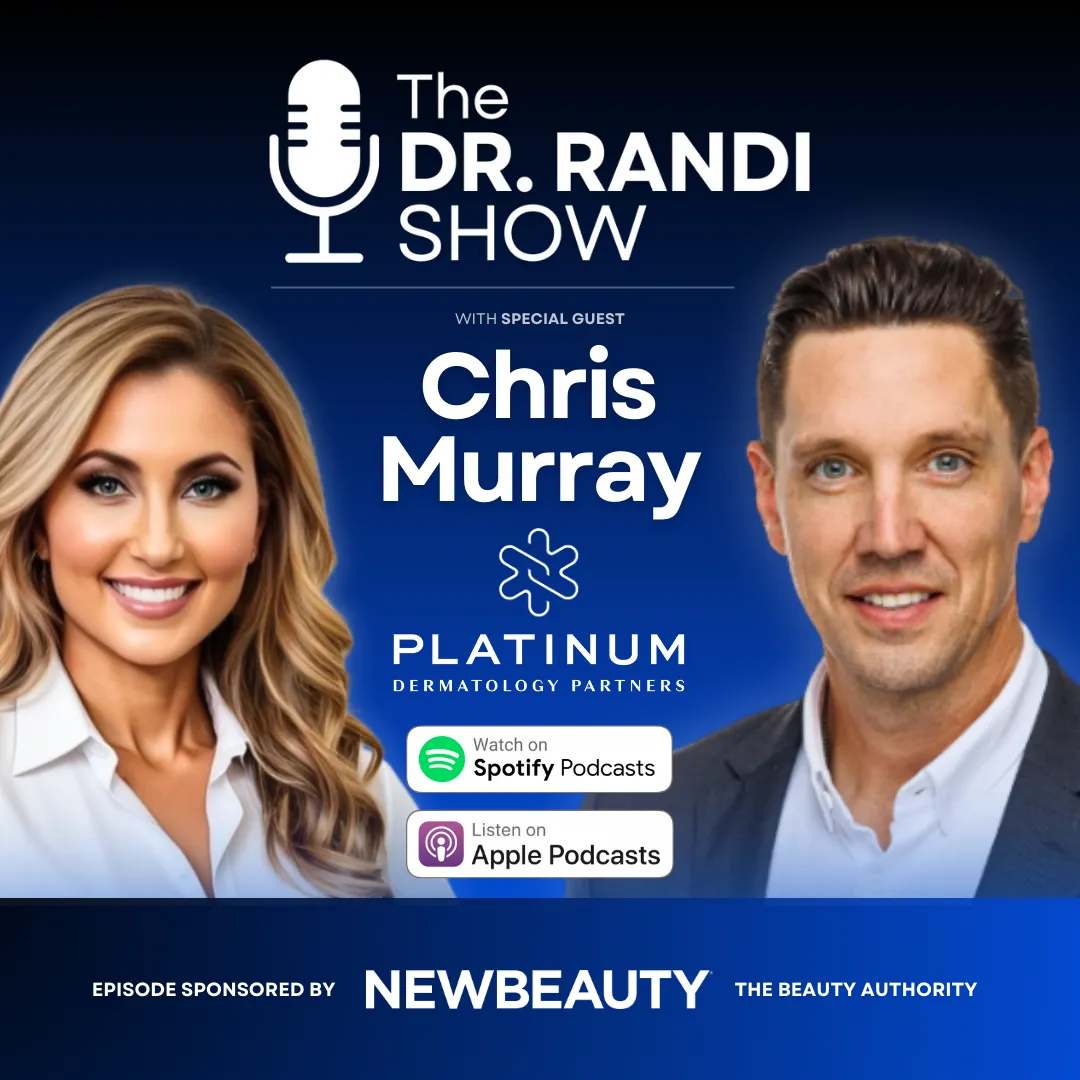
This week, I sit down with Chris Murray of Platinum Dermatology Partners, one of the country’s largest dermatology networks, with more than 100 locations and 2 million unique patients a year. Chris breaks down how dermatology and aesthetics are finally functioning as one connected ecosystem, centered on skin health, long-term planning, and strong patient outcomes.
Chris shares how Platinum’s presence across the major beauty markets of Southern California, Arizona, Las Vegas, Dallas, and Miami, gives them a front-row seat to what patients truly want. He explains how dermatologists often see things patients overlook entirely, why education matters more than selling, and why consistency, training, and volume are what separate great injectors from everyone else.
We explore what’s evolving inside dermatology-led aesthetics: the rising demand for devices overall, the momentum behind energy-based treatments, and why technologies like Moxi, BBL, IPL, and microneedling continue to be among the most requested options across their clinics. Chris also talks about bio-regenerative medicine, the difference between real science and hype, and why skincare remains one of the most underestimated components of an effective anti-aging plan.
The episode wraps with a rapid-fire speed round where Chris shares candid, no-filter takes on the skincare and aesthetics questions people ask every day.
If you’ve ever wondered what it looks like when a major dermatology organization steps confidently into the future of aesthetics, this conversation gives you a rare inside look, directly from the person helping steer it.
Sponsored by NewBeauty 💄
📱 Listen and Watch on Spotify: https://spti.fi/gQciEl3
🎧 Listen on Apple Podcasts: https://dub.link/bpvGYVt
Episode FAQ
What is Platinum Dermatology Partners, and how does it approach dermatology and aesthetics?
On The Dr. Randi Show, Chris Murray, who helps lead the dermatology group Platinum Dermatology Partners, described it as a white label company, meaning it keeps the original names of the practices it operates rather than rebranding them. He explained that the group grew through mergers and acquisitions into roughly 125 locations across Southern California, Arizona, Las Vegas, Dallas, and Miami, and sees about 2 million unique patients a year. General dermatology makes up about 80 percent of the business and aesthetics about 20 percent, and he said the footprint is placed deliberately in fast growing aesthetic markets so the two sides can support each other. This reflects Chris Murray’s personal and professional experience and is not medical advice.
Why should you see a dermatologist for aesthetic treatments instead of only an aesthetic clinic?
During this episode of The Dr. Randi Show, the guest made the case for starting your aesthetic journey with a dermatologist. He described it as part of a holistic plan that treats the skin as the largest organ, noting that board certified and double board certified dermatologists are trained to spot underlying conditions and address root causes before treating aesthetically. In his view, a dermatology practice can act as a one stop shop for skincare, treatments, and injectables, which is especially helpful if you have had a skin condition in the past and want to confirm your skin is ready for a given treatment. This reflects the guest’s personal experience and is not medical advice.
How does skin health affect anti-aging and beauty results?
On The Dr. Randi Show, the guest explained that skin health is the foundation of anti-aging and beauty, and that different treatments work together synergistically. He used sunscreen as an easy example, comparing getting a neurotoxin without leaving with sunscreen to going to the dentist for a cleaning and then not brushing your teeth at home. He noted that prevention and maintenance, from sunscreen to a mix of energy based treatments, matter as much as any single procedure. This reflects the guest’s personal experience and is not medical advice.
Which aesthetic treatments and devices are growing the fastest right now?
The guest told The Dr. Randi Show that energy devices have been the surprise growth story, expanding by double digits, while injectables continue to grow steadily even when the economy shifts. He said that across the group’s practices, some of the strongest performers are the Moxi and BBL, with microneedling also very popular and IPL a natural fit for busy general dermatology offices. He pointed to Cosmetic Laser Dermatology in San Diego, which he said has more than 60 devices and draws patients from around the country. This reflects the guest’s personal experience and is not medical advice.
Do patients come in asking for specific devices, or does provider education drive it?
On The Dr. Randi Show, the guest shared his opinion that patients mostly do not walk in asking for a specific device by name, because it takes enormous marketing investment for any device brand to become recognizable to consumers. He said device treatments usually happen because the office has the right device coverage and a provider recommends it during a routine visit, the way his host was introduced to CO2 laser treatment. He framed this as education rather than selling, since patients often do not know their options unless a trusted provider walks them through it. This reflects the guest’s personal experience and is not medical advice.
What do dermatologists bring to injectables like Botox and fillers?
During the episode of The Dr. Randi Show, the guest said the two things that matter most when choosing an injector are training and volume. He encouraged consumers to look at a provider’s credentials and how much hands-on training they have completed, sharing that Platinum ran 17 hands-on trainings across its locations in a single month. He compared injecting to cutting hair, explaining that someone who treats many patients every day tends to be more proficient than someone who injects only occasionally. This reflects the guest’s personal experience and is not medical advice.
What is an aesthetic treatment plan, and how often should you see your provider?
The guest explained on The Dr. Randi Show that an aesthetic treatment plan means sitting down with your provider, starting from the result you want, and working backwards to map out treatments over time. He suggested coming in every three to four months rather than waiting until the holidays, and pointed to medical grade skincare as an easy anchor, since it is often sold in roughly 12 week, three month supplies. He added that if a new provider does not walk you through a consultation about long term goals, that can be a sign they may lack the training. This reflects the guest’s personal experience and is not medical advice.
What new innovations are coming in aesthetics over the next few years?
On The Dr. Randi Show, the guest said he is most excited about bio-regenerative medicine and a wave of new treatments now working through the research and approval process. He used Sculptra as an example of a biostimulator that took years of trial, refinement, and a five year safety study before it took off, and he noted that some newer products are following a similar path while the science catches up to them. He framed wellness and regenerative approaches as a natural extension of treating the skin holistically. This reflects the guest’s personal experience and is not medical advice.
How should you think about exosomes and stem cells in skincare?
The guest told The Dr. Randi Show that exosomes and stem cells are still early, and that their safety and effectiveness depend a great deal on how they are used. He said topical use can be relatively safe, while injecting these ingredients raises questions the field cannot fully answer yet. His main advice was to be cautious with the word science and to ask a board certified provider about the actual data behind a product, such as how many people were in a study and whether basic safety work has been done. This reflects the guest’s personal experience and is not medical advice.
What is the most underrated skincare step people overlook?
On The Dr. Randi Show, the guest said skincare itself is the most overlooked part of an aesthetic routine, and that with devices and injectables filling most of the day it does not get discussed enough. For a simple daily routine he described washing the face, applying vitamin C, layering products thin to thick, and finishing with sunscreen, which he called the one step you should never skip. He also pointed to newer ingredients like copper peptides as an example of how quickly the skincare space is producing new options. This reflects the guest’s personal experience and is not medical advice.