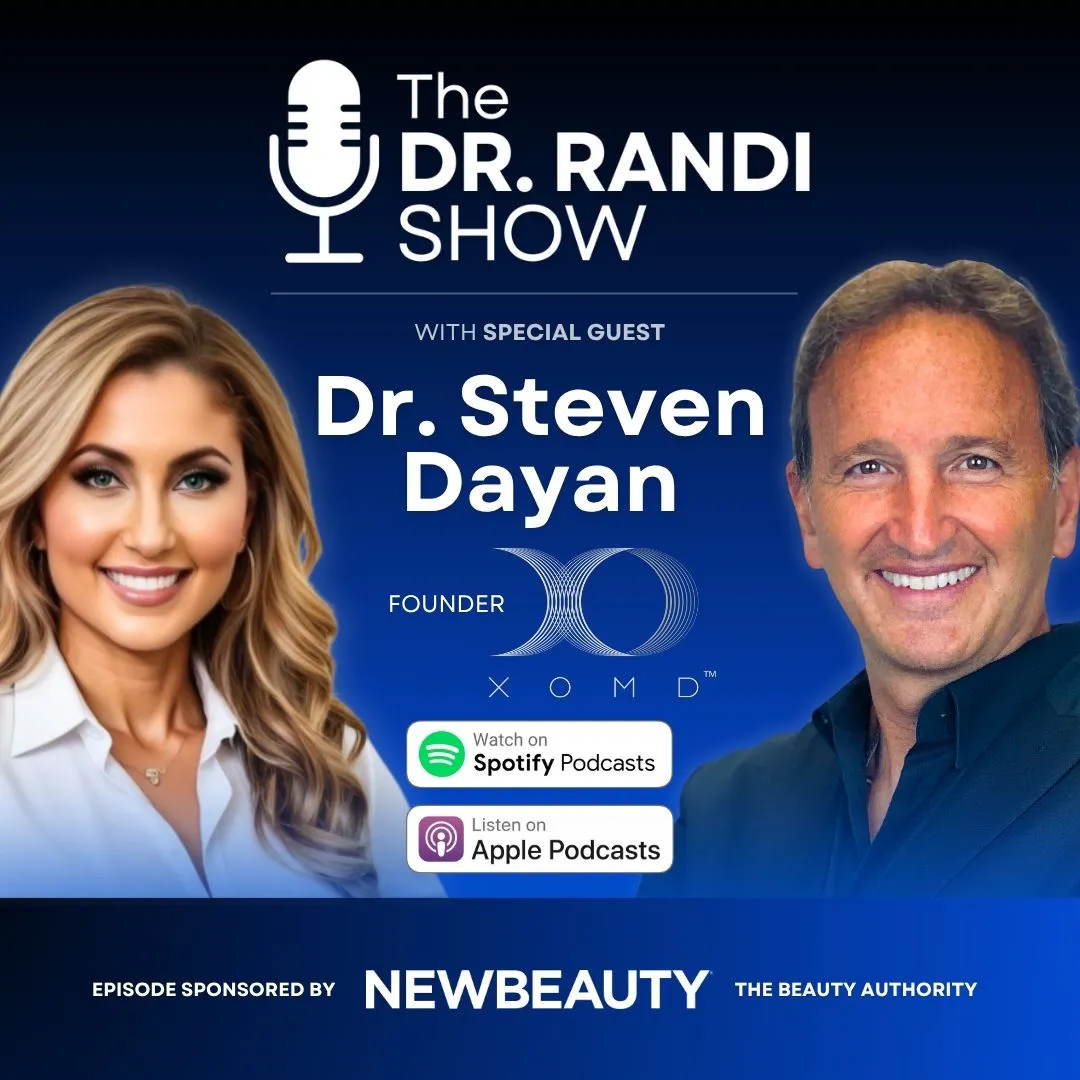
Dr. Randi sits down with Steven Dayan — renowned facial plastic surgeon, bestselling author, and creator of XOMD SKINCARE, the first-ever “moodceutical” skincare line that can boost mood, confidence—and maybe Your Sex Life!
Together, they unpack the science behind a formula designed to elevate skin and emotion, with clinical trials showing boosts in glow and even intimacy. This is skincare like you’ve never seen it—and it’s backed by real data, not just hype. This episode is sponsored by NewBeauty 💄
🎧Watch & Listen on Spotify: https://spti.fi/pryxJPc
🎧Listen on Apple Podcasts: https://apple.co/3Zv8mEx
Episode FAQ
What is mood skincare, and what inspired the first mood skincare line?
On this episode of The Dr. Randi Show, facial plastic surgeon, author, and educator Dr. Steven Dayan shared the story behind XOMD, which he describes as the first mood skincare line, created with his partner, cosmetic dermatologist Dr. Sabrina Fabi. Dr. Dayan explained that over 25 years in practice he realized he could create a technically perfect nose or eyes and still not have a satisfied patient, because so much of the work is about how a person feels. He estimated that about 70 percent of what he does day to day is treating emotion rather than the physical, and said XOMD grew out of more than 20 years of his research into beauty, attraction, and happiness. The goal, in his words, is skincare that supports both skin quality and emotional wellbeing. This reflects Dr. Dayan’s professional perspective as a co-founder of the brand and is not medical advice.
What is the skin brain axis, and how does oxytocin affect the skin?
On The Dr. Randi Show, Dr. Steven Dayan explained that the skin contains thousands of neurons along with neurohormones such as norepinephrine, serotonin, dopamine, and oxytocin, and that the skin and brain communicate through what he called the skin brain axis. Dr. Dayan described oxytocin as having notable effects at the skin level, including increased blood flow, anti-inflammatory and antioxidant activity, and support for wound healing. He also described how touch, such as a hug, can raise oxytocin in the skin and signal the brain to release more, which he linked to feeling good, feeling closer to a partner, and being more social. He pointed to the glow people often notice during pregnancy or when someone is in love as an example of that effect. This reflects Dr. Dayan’s professional perspective and is not medical advice.
What ingredients are in XOMD skincare, and does it contain oxytocin?
On The Dr. Randi Show, Dr. Steven Dayan said XOMD is built around a proprietary formula called OX Factor, which has three components that he and his partner are working to patent. Dr. Dayan described the first as a jasmine derivative that he said acts on receptors in the skin, as part of the formula’s goal of mimicking the effects of oxytocin; the second as phospholipids to support skin quality; and the third as a pheromone, which he added because he believes these chemical messengers released from the skin can influence how others respond. He was clear that the product does not contain oxytocin itself and is instead designed to mimic and build on its effects. He also shared that the serum and moisturizer come in interlocking X and O packaging that took more than a year to perfect, with travel sizes in development. In the episode’s speed round, he named jasmine as his favorite skincare ingredient right now, and his best skincare advice in five words or less was simply sunscreen. This reflects Dr. Dayan’s description as a co-founder of the brand and is not medical advice.
What did the clinical trial on XOMD mood skincare find?
On The Dr. Randi Show, Dr. Steven Dayan said he and Dr. Sabrina Fabi would not put their names on XOMD without testing it in a double blind, placebo controlled, randomized trial, the kind of rigorous testing he noted most skincare products never undergo. According to Dr. Dayan, participants saw improvements in skin quality and radiance, and self-reported confidence rose between four and eight weeks, with gains he cited of up to 86 percent, while the placebo group did not show a similar effect. He said observers who did not know participants had used anything rated them more favorably across eight first impression categories, including attractiveness and appearing socially and financially successful. He described the most surprising finding as sexual satisfaction: women who used XOMD for eight weeks improved in 18 of 20 categories on a validated scale, compared with no improvement in the placebo group. Dr. Dayan stressed that XOMD is not a sex cream and that skin quality and glow remain its primary focus. These are study results as described by a co-founder of the brand, individual experiences vary, and this is not medical advice.
How long does it take to see results from mood skincare?
On The Dr. Randi Show, Dr. Steven Dayan said that, anecdotally, some clinical trial participants reported starting to feel better within about two weeks as they noticed a glow. Dr. Dayan explained that the trial formally measured results at four and eight weeks, with improvements appearing at four weeks and becoming statistically stronger by eight weeks. Because the study ended at eight weeks, he said he cannot say for certain whether results would keep improving beyond that point. His general guidance is to expect to start feeling better about yourself and to notice a glow around the four week mark. This reflects Dr. Dayan’s description of his company’s study and is not medical advice, and individual results vary.
What does prosocial aesthetics mean, and where is aesthetic medicine heading?
On The Dr. Randi Show, Dr. Steven Dayan described how aesthetic medicine has measured success in stages. In his framing, the first order focused on creating mathematically ideal faces, the second on patient reported outcomes such as self-esteem and quality of life, which he said became more common in the late 1990s and early 2000s, and the third on observer reported outcomes, meaning whether other people think a patient looks better or more natural. Dr. Dayan is introducing what he calls a fourth order: whether treatments such as Botox, filler, lasers, or facials actually improve a person’s social life and interactions. He believes future clinical trials across aesthetics will increasingly measure these prosocial benefits, a direction he said XOMD is helping pioneer. This reflects Dr. Dayan’s professional perspective and is not medical advice.
How are aesthetic medicine, sexual wellness, and GLP-1 medications coming together?
On The Dr. Randi Show, Dr. Steven Dayan said aesthetic medicine is increasingly overlapping with sexual health and wellness, with both fields growing quickly and in parallel alongside holistic medicine. Dr. Dayan noted that GLP-1 medications such as Ozempic are also entering the aesthetic space, with many plastic surgeons and aesthetic providers now offering them, and he said they can influence mood and how people feel about themselves. He observed that at medical conferences, plastic surgery sessions on techniques like the deep plane facelift and dermatology sessions on topics like rosacea and collagen are starting to merge into shared conversations, and he expects more crossover between these fields in the near future. This reflects Dr. Dayan’s professional perspective and is not medical advice.
How is TikTok being used to share the science of attraction?
On The Dr. Randi Show, Dr. Steven Dayan shared that his TikTok presence started almost by accident. A young team member in his office often asked him dating and attraction questions, and Dr. Dayan answered them drawing on his background in the science of attraction, including his many published articles, the undergraduate course on the science of beauty he taught at DePaul University for 10 years, and his New York Times bestselling book, Subliminally Exposed. She began filming his answers and posting them, and he said his account grew from zero to about 90,000 followers in three months, with topics expanding into relationships. He joked that the best part is that his kids now think he is cool, although in the speed round he still picked Instagram over TikTok. This reflects Dr. Dayan’s personal experience.
What is it like for a plastic surgeon to treat celebrity patients?
On The Dr. Randi Show, Dr. Steven Dayan, who practices in Chicago, shared that celebrities often come through when they are in town for an event or show. Dr. Dayan said he has closed his office at an agent’s or publicist’s request only to have the patient not show up, and that some patients arrive under a false name. In his experience, true A-listers tend to be kind and appreciative, while those who want to be A-listers are more often rude. His main advice to younger surgeons is to treat celebrities like every other patient, because in his view, care can suffer once a provider starts going out of the way to do things differently for someone famous. This reflects Dr. Dayan’s professional experience and is not medical advice.
Is a deep plane facelift pulled vertically or horizontally?
On The Dr. Randi Show, responding to discussion of a widely talked about celebrity facelift, Dr. Steven Dayan explained that a deep plane facelift is just one way of approaching the face, and that the lift can be directed vertically or horizontally, so the two are not mutually exclusive. Dr. Dayan added that a very defined chin and jawline can also come from additional steps, such as chin augmentation, jawline work, or sculpting the platysma muscle, though he noted it is hard to say exactly what was done in any one case. In the speed round, he said Kris Jenner is the celebrity look patients request most right now, and that larger lips are the procedure patients most often request because of Instagram. This reflects Dr. Dayan’s professional perspective and is not medical advice.