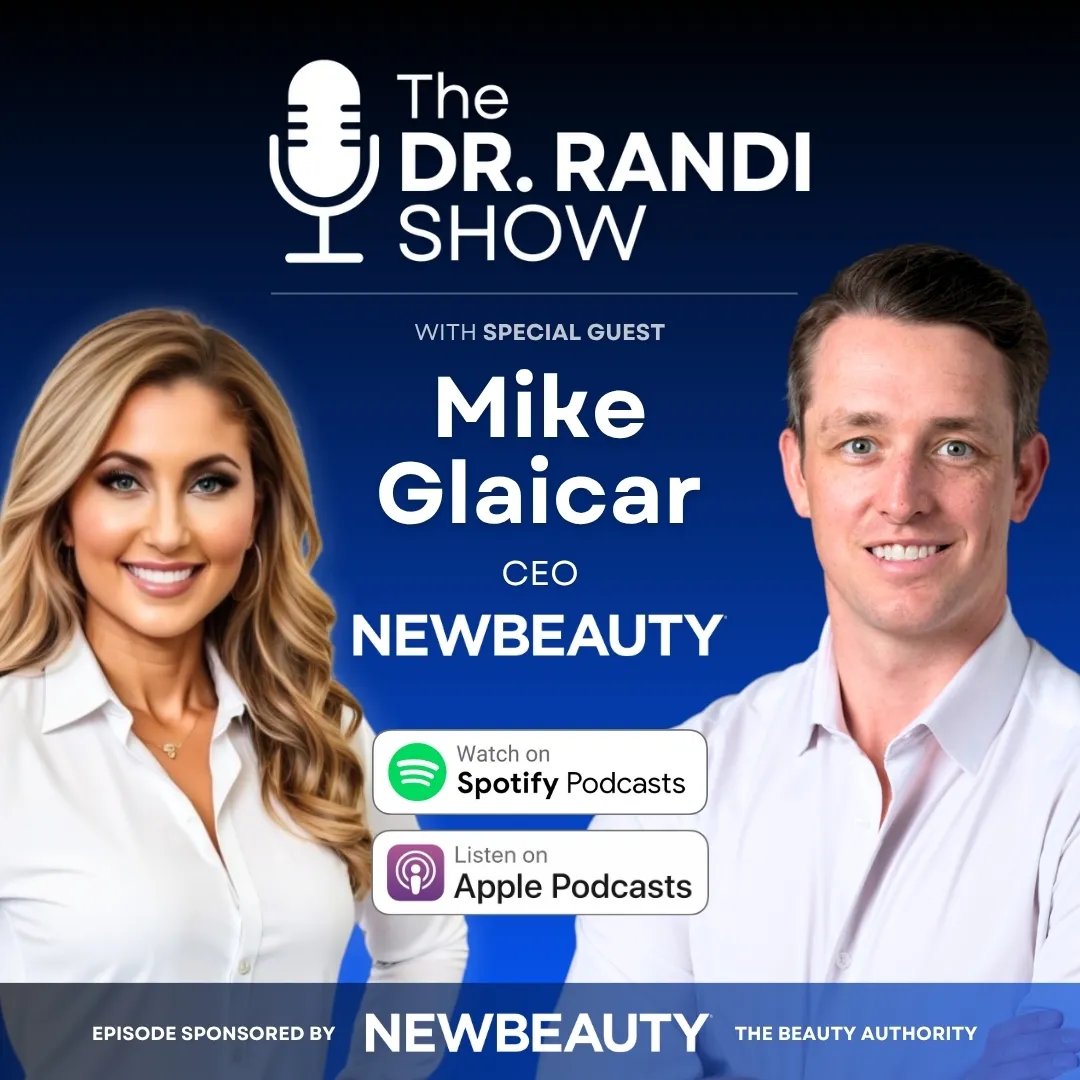
What happens when one of beauty’s most iconic brands evolves into a full-scale insights and activation platform?
Dr. Randi sits down with Mike Glaicar, CEO of NewBeauty to talk about the brand’s transformation—covering everything from its acquisition by MJH Life Sciences® to the development of Beauty Engine, the rise of the BeautyPass program, and how the White Glove Program is giving aesthetic clinics new ways to engage patients.
They also explore how practices are adapting to the GLP-1 era by integrating aesthetic treatments into the conversation, and the growing importance of provider-driven events in today’s competitive landscape.
A revealing look at how NewBeauty is shaping the future of aesthetics—online, in-office, and beyond.
🎧Watch & Listen on Spotify: https://spti.fi/jCu8mUH
🎧Listen on Apple Podcasts: https://apple.co/4kv7mZx
Episode FAQ
What is New Beauty and what is changing for the brand after its acquisition by MJH Life Sciences?
On The Dr. Randi Show, New Beauty CEO Mike Glaicar discussed the brand’s acquisition by MJH Life Sciences, which he described as the largest privately held medical communications company in North America, specializing in educating healthcare professionals across specialties such as oncology and dermatology. Mike Glaicar explained that New Beauty has spent 20 years educating aesthetic consumers, and that the acquisition allows the brand to quickly expand its work educating and providing value to aesthetic providers as well. He noted that he began his own career at MJH Life Sciences with Pharmacy Times, so the move felt like a homecoming. The episode also covers New Beauty’s Beauty Engine data business, aesthetic industry trends, provider events, and a patient mailing program.
What is Beauty Engine from New Beauty?
Beauty Engine is New Beauty’s consumer data and insights business, which Mike Glaicar described on The Dr. Randi Show as a secret weapon for the brand over the past four years. He explained that aesthetic industry data is often scattered, with patient stories from one provider not matching those from another, so New Beauty set out to bring consumer insight together in one place. Beauty Engine is built on Beauty Pass, New Beauty’s invite-only membership for consumers who want to try beauty and skincare products, which Mike Glaicar said includes about 90,000 consumers across the United States who can be reached by text message. Insights from this panel feed New Beauty’s State of Aesthetics report and the weekly Beauty Engine Pulse data posts, and Mike Glaicar called Beauty Engine the fastest growing division of the business.
How does Beauty Engine conduct consumer research for aesthetic and beauty brands?
According to Mike Glaicar, Beauty Engine surveys its panel of engaged aesthetic consumers by SMS, with response rates he described as about 60 to sometimes 70 percent. He explained that to collect 1,000 responses, New Beauty might text only 1,500 to 1,700 panel members, while traditional market research could require reaching out to 100,000 people. This allows the team to run three to five studies a week. Mike Glaicar said partners range from large manufacturers to startup beauty companies, and gave Galderma Aesthetics as an example of a partner that commissioned studies on topics such as GLP-1s, the state of fillers, and regenerative medicine, with thousands of consumers responding. Studies can gather feedback on ingredients, packaging, and product types, and can also put products in consumers’ hands before launch for early reviews.
What is the hourglass model for beauty product development?
Mike Glaicar described the hourglass model as New Beauty’s alternative to what he called the traditional triangle model of product development. In the triangle model, a small group such as a cosmetic chemist and a few executives develop a product in a boardroom and release it to millions of consumers, which he characterized as a guess and check approach that sometimes misses. In the hourglass model, thousands of consumers first share feedback on ingredients, packaging, and the types of products they want; that data is distilled for the small product development team; and the finished product then goes back out to millions of consumers. Mike Glaicar said he hopes this consumer-first approach becomes the gold standard, because consumers know what they want, what is trending, and what their skin type may need.
How are GLP-1 weight loss medications affecting the aesthetics industry?
Mike Glaicar shared on The Dr. Randi Show that about a third of New Beauty’s audience is either on GLP-1 medications or has taken them in the past, a number he said has steadily increased. He explained that the industry initially expected a distinct post-GLP-1 phase, but that this is not really happening, since some patients titrate back or continue microdosing in some capacity. From his perspective, providers need to think about treating patients during their GLP-1 process with holistic care rather than waiting until weight loss is complete. He also noted that New Beauty’s data with Galderma showed new consumers entering aesthetics for the first time because they felt better about themselves, and that many consumers reported skin laxity, texture, and quality concerns and wished they had started aesthetic treatment earlier. Mike Glaicar described the message to providers as being proactive rather than reactive. This reflects his view of consumer data and is not medical advice.
What is the invisible aesthetics trend?
Mike Glaicar named invisible aesthetics as a major trend New Beauty was seeing for 2025. He described it as a shift away from enhancing specific features, such as asking to enhance the cheeks or lips, toward facial balancing and a natural look. In his words, the goal is for friends or family to say you look great without being able to put their finger on what you did. He contrasted this with what he felt was more common about five years earlier, when consumers more often asked to enhance individual features.
Why is patient experience as important as results in aesthetic treatments?
Mike Glaicar said New Beauty’s data shows the patient experience has become just about even with patient results in how consumers judge aesthetic treatments and procedures. He explained that results used to be the main measure, so a strong result could make up for a poor experience, but that amazing results are now table stakes. According to the data he shared, about 77 percent of consumers said their biggest turnoff was a negative interaction with a physician’s bedside manner. Mike Glaicar noted this is encouraging because it is free to fix, since treating patients with respect costs nothing, and said New Beauty is now training providers on patient experience while manufacturers focus their training on patient outcomes. He added that an aesthetic visit should feel almost like a holiday or vacation for the patient.
How can aesthetic practices send New Beauty to their patients?
Mike Glaicar described a New Beauty program that lets providers send copies of the publication directly to their patients and prospects. Through a backend portal, a practice uploads the names and addresses of the contacts it wants to reach, and New Beauty handles mailing each copy with a customized letter from the office. As an example, he suggested a practice could reach patients who have not visited in six months but have spent over $5,000 lifetime, sending them a copy each quarter with a letter welcoming them back and highlighting a new device or promotion. Mike Glaicar compared the logistics to a postcard campaign, but with a $13 valued issue of 150 to 200 pages, and said the personal, printed format helps cut through the noise of digital messaging at a time when print is having a resurgence.
What events is New Beauty planning for aesthetic providers?
Mike Glaicar said events are a major focus for New Beauty, supported by MJH Life Sciences, which he said runs close to 1,800 events a year across specialties. He described smaller custom events that bring together key opinion leaders in dermatology, plastic surgery, and the med spa space for knowledge sharing, noting that even providers with 30 years of experience learn something new from their peers. New Beauty plans to share the resulting best practices with providers across the country. He also mentioned Beauty Pass Live, a New York City event planned for November with over 600 consumer and provider attendees. Mike Glaicar encouraged providers to ask New Beauty for the data they want and to use the brand as a source of truth.
How does New Beauty maintain credibility in aesthetic and beauty content?
Mike Glaicar credited New Beauty’s editorial team and its medical advisory board, including Dr. Robert Singer, with holding the brand to a very high standard over its 20 years, noting that everything it publishes is vetted. He described New Beauty as more of a coffee table book than a magazine, with 150 to 200 pages of vetted aesthetic and beauty content that is credible yet digestible, without dumbing the information down. He added that New Beauty is distributed through about 250 private airports in the United States and, according to him, is consistently the most taken magazine among private jet travelers. Mike Glaicar said the brand will continue its mission of educating consumers while expanding its support for providers.