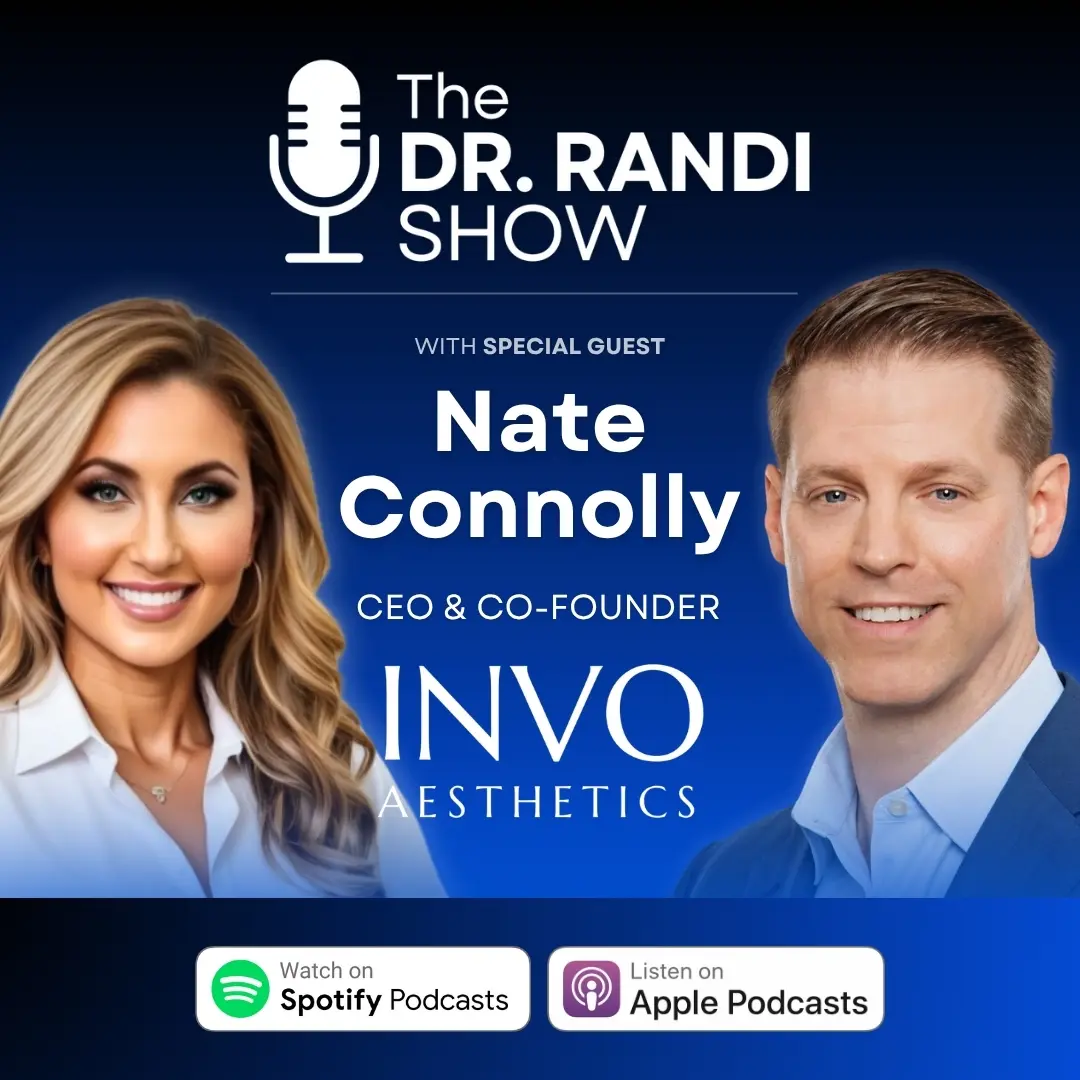
Nate Connolly, CEO and Co-founder of Invo Aesthetics sits down with Dr. Randi to demystify one of the most talked-about (and misunderstood) innovations in aesthetics: Exosomes.
Dr. Randi and Nate Connolly break down what exosomes actually are, how they differ from growth factors and peptides, and why Invo’s proprietary “BioBlend” technology is setting a new standard for skin and hair rejuvenation. From clinical-grade formulations and physician-backed protocols to surprising early results and the future of regenerative aesthetics, this conversation pulls back the curtain on what’s hype, and what’s real.
Episode FAQ
What are exosomes, and what does this episode of The Dr. Randi Show cover about them?
On this episode of The Dr. Randi Show, host Dr. Randi Boyette spoke with Nate Connolly, CEO and co-founder of INVO Aesthetics, who has spent almost 20 years in the medical grade skincare industry. The conversation set out to clear up the confusion around exosomes. Nate Connolly explained how exosomes differ from growth factors, how in-office and at-home exosome treatments compare, and how long results may take. He also addressed common safety myths, the growth of hair restoration, how practices use exosome products alongside procedures, and the challenges of launching an aesthetics startup. The answers reflect his personal experience and opinions and are not medical advice.
What is the difference between growth factors and exosomes in skincare?
On The Dr. Randi Show, Nate Connolly described growth factors as larger proteins or peptides that send a general signal to the body, working like a lock and key to turn on processes such as collagen and elastin production. He described exosomes as much smaller nanoparticles that deliver a more concentrated, specific message into the cell. His analogy: a growth factor says “meet me at Home Depot,” while an exosome says “meet me at Home Depot in aisle three by the hammers and nails.” In his view, combining growth factors and exosomes in one product creates a synergy that works better than either alone. This reflects his professional perspective and is not medical advice.
How do in-office exosome treatments differ from at-home exosome skincare?
Speaking on The Dr. Randi Show, Nate Connolly said the main difference is concentration. He explained that most companies provide a higher concentration of growth factors and exosomes for in-office use alongside a treatment, to jumpstart the desired result, whether that is rejuvenation for fine lines and wrinkles, pigment, or hair restoration. Take-home products, in his description, use a smaller concentration and serve as daily maintenance, helping patients keep and build on the results they got in the office. This reflects his professional perspective and is not medical advice.
How is a multi-source exosome blend different from a single-source exosome product?
On The Dr. Randi Show, Nate Connolly explained that most exosome companies use a single source, such as plant-based or one human-derived source like adipose, bone marrow, or fibroblast. In his view, a single source limits a product to the benefits of that one source. He said INVO Aesthetics uses a proprietary, patent pending blend of multiple human-derived sources (bone marrow, umbilical, and fibroblast), chosen for their clinical background in wound healing, rejuvenation, inflammation, and hair restoration. He added that the company’s stem cell PhDs use proprietary lab methods to create what it calls BioBlend technology, a combination of growth factors, peptides, and exosomes meant to condense a multi-step routine into one product. These are his descriptions of his company’s approach and are not medical advice.
How long does it take to see results from exosome and growth factor skincare?
Asked this on The Dr. Randi Show, Nate Connolly said that with his company’s take-home product, people may start to notice results in about four to six weeks, with the most dramatic results in the eight to 10 week range, or roughly midway through a second bottle. He framed major results as taking a good skin cycle or two. Individual results vary, and this reflects his professional perspective rather than a guaranteed outcome or medical advice.
Can exosome products spread disease or transfer someone else’s DNA?
On The Dr. Randi Show, Nate Connolly said the most common myth he hears about exosomes is the fear of catching a disease or getting someone else’s DNA from the source material. He said the industry needs to do a better job of educating people, and advised choosing a company that goes through stringent testing, works with a reputable third-party facility, and sources its exosomes responsibly. He also said he partners with physicians because they research products carefully before bringing them into their practices. This reflects his professional perspective and is not medical advice.
Are exosomes and growth factors being used for hair restoration?
Yes, according to Nate Connolly on The Dr. Randi Show. He said hair restoration is an area he expects to keep growing, and that in the physician space the hair market is still at the tip of the iceberg compared with facial rejuvenation. He noted that physicians are excited to keep hair restoration in-house rather than referring it out. He also shared that some users of his company’s hair product have said they think it helps with gray hair, while stressing there is no clinical data on that and it may be a placebo effect. This reflects his personal perspective and is not medical advice.
How can dermatologists, plastic surgeons, and med spas add exosome products to their practice?
On The Dr. Randi Show, Nate Connolly described a two-step approach: an in-office exosome solution paired with procedures such as a peel, microneedling, or laser treatments, followed by a matching take-home product for maintenance. He said his company offers single-use 3 ml vials per patient and procedure to keep costs down, and works primarily with aesthetic dermatologists, plastic surgeons, and med spas with a medical director on staff, not spas, salons, or retail. He added that the products can be bought on the company website at a 30% higher price so providers are not undercut, are not sold through third-party retailers like Amazon, and come with a 90-day money back guarantee for practices. These details reflect what he shared at the time of recording.
What challenges do founders face when launching an aesthetics skincare startup?
On The Dr. Randi Show, Nate Connolly said the biggest early challenge for his company was funding. He explained that private equity, venture capital, and angel investors liked the idea but said it was too early and to come back with more traction. His solution was to lean on physician providers and partners, making the company privately owned and physician funded. He said other founders warned him to be prepared to work nonstop with little sleep, but that it would be incredibly rewarding, and he described entrepreneurship as learning from mistakes and moving forward, adding that founders need to be “a little bulletproof and a little crazy.”
Where is regenerative aesthetics and exosome skincare headed?
On The Dr. Randi Show, Nate Connolly said his market research pointed to continued growth in both facial rejuvenation and hair restoration, with the industry leaning further into stem cell and regenerative aesthetics. He said most providers are now seeing the value of exosomes and looking for the right partner. For his own company, he described plans for a take-home brightener and a take-home hair restoration product, more clinical studies, and a goal of about 10 to 15 products, avoiding a large lineup of “me too” products in favor of a streamlined, science-based line backed by third-party data. This reflects his personal outlook at the time of recording.