Korean skincare changed the global beauty conversation but what happens when one of the voices who helped build it starts challenging everything it became known for?
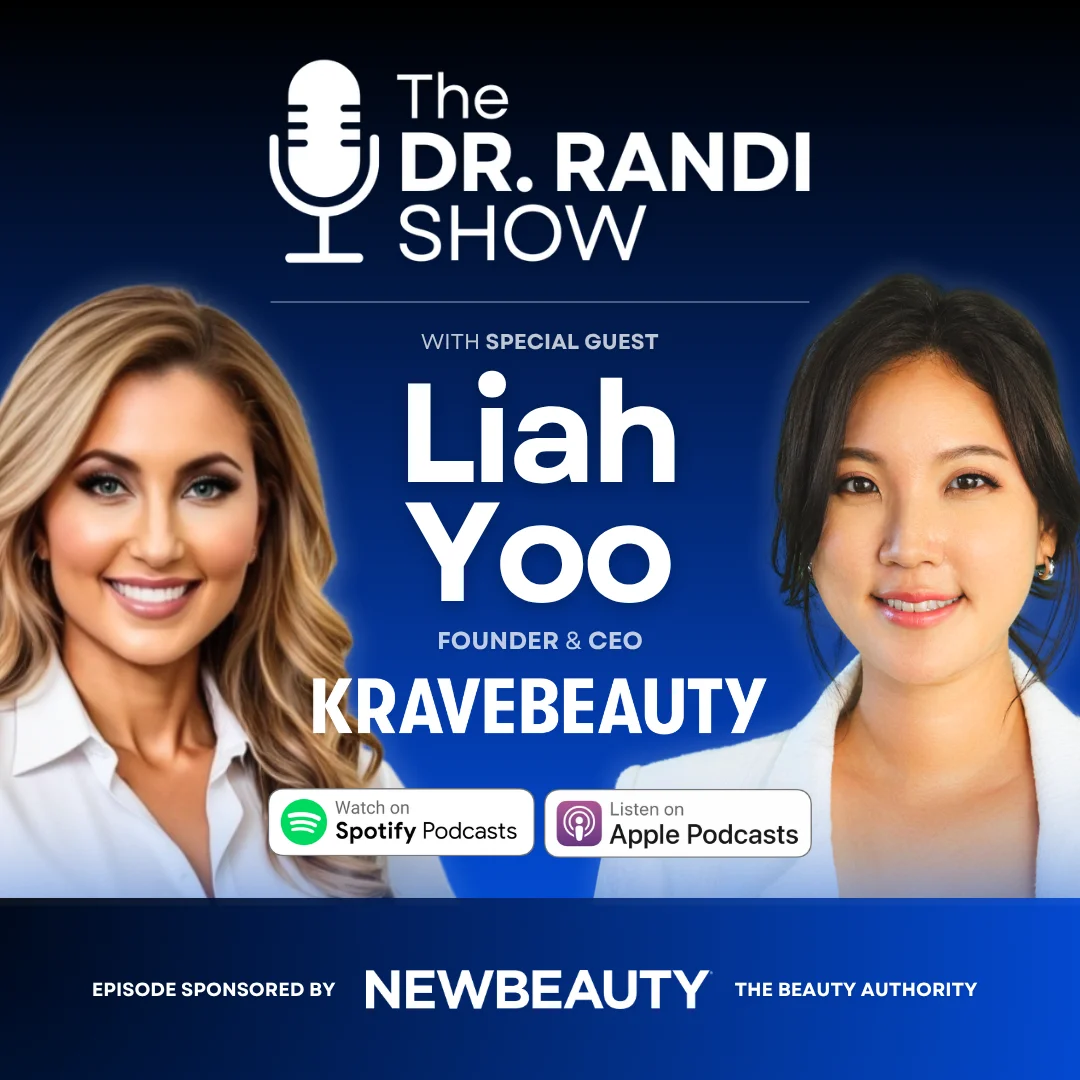
On this episode of The Dr. Randi Show, Dr. Randi sits down with Liah Yoo, founder and CEO of KraveBeauty. With more than 1 million subscribers and roughly 100 million views, Liah built one of the most influential platforms in skincare by teaching people how to understand their skin and then turned that trust into one of the most talked-about brands in beauty today.
This is a deeper conversation around Korean beauty, how it shaped the industry, how it’s evolved, and what it looks like now through the lens of someone who has been at the center of it.
You’ll hear how products like Oil La La, Great Barrier Relief, and Lip Barrier Relief came to life, how her audience helped shape the brand, and why a more focused approach to skincare is resonating at such a massive level.
In this episode, we cover:
🔵 Why multi-step routines don’t always lead to better skin
🔵 The real role of skin barrier health
🔵 The relaunch of Oil La La and a different way to approach acne care
🔵 Kelp CoLab and a new approach to collaboration in beauty
🔵 Where skincare and skin health are headed next
This episode is a real conversation about Korean beauty, what defines it, what sets it apart, and how it continues to evolve at the highest level of the industry.
Sponsored by NewBeauty 💄
📱 Listen and Watch on Spotify: https://spti.fi/I0QfHDO
🎧 Listen Now on Apple: https://dub.link/nqHIZ03
Episode FAQ
What is Krave Beauty’s skincare philosophy?
On The Dr. Randi Show, Liah Yoo, founder and CEO of Krave Beauty, shared the less-is-more philosophy behind her brand. She explained that she built Krave Beauty around skin minimalism, encouraging people to strip back overloaded routines and listen to what their skin is actually signaling rather than following every trend or influencer. In her experience, especially for anyone dealing with a compromised skin barrier, acne-prone skin, or eczema, fewer but better products let the skin do its natural job and thrive. She described skin as a living, breathing organ that is constantly communicating, and said she wishes more people trusted how smart their skin is. This reflects the guest’s personal and professional perspective and is not medical advice.
Why is using fewer skincare products better for your skin?
During this episode of The Dr. Randi Show, the guest explained that the social media era has left many people in a kind of analysis paralysis, feeling that without a 10-step routine they have no routine at all. She shared that this pressure to keep adding products can overwhelm or even damage the skin, and she pointed to her own past of burning her skin barrier by layering too many actives. Comparing it to an elimination diet, she noted that it is hard to tell which of 14 products is causing a reaction, so simplifying makes it easier to see what your skin truly needs. She also referenced a Korean skincare diet trend built on elimination and simplification that shaped her approach. This reflects the guest’s personal experience and is not medical advice.
How do you build a simple, minimalist skincare routine?
On The Dr. Randi Show, the guest recommended starting with the bare basics: a cleanser, a moisturizer, and a sunscreen, which she called the non-negotiables for maintaining a healthy skin barrier. In her approach, anything beyond those three is supplementary and should be chosen based on your specific skin goals or concerns, such as hyperpigmentation, a broken barrier, or eczema. She suggested keeping ingredient lists as simple as possible to reduce the chance of breakouts or irritation, and giving a new routine about two weeks to see how your skin responds before adding anything else. She also stressed that supplementary products do not need to be used every single day. This reflects the guest’s personal approach and is not medical advice.
Can facial oils help acne-prone skin?
The guest discussed how oils can actually benefit acne-prone skin, which she described as a turning point in how she thinks about breakouts. She shared that after years of using stripping, oil-free, harsh products that left her skin paper-dry, she came across research showing that acne-prone skin is often deficient in a fatty acid called linoleic acid. In her view, replenishing that fatty acid topically can help rebalance the skin rather than fight it, whereas approaches focused only on killing acne-causing bacteria can harm the skin microbiome and barrier. This insight is what led her to create Oil Lala, a linoleic-acid-rich oil serum. This reflects the guest’s personal and professional experience and is not medical advice.
What are Krave Beauty’s core products, and where should beginners start?
On The Dr. Randi Show, the guest walked through Krave Beauty’s core lineup and suggested newcomers begin with the basics. She highlighted the Matcha Hemp Hydrating Cleanser, an antioxidant-packed gentle cleanser designed to do no harm to the skin barrier; the Oat So Simple Water Cream, a lightweight moisturizer made with only nine ingredients and suited to oily, acne-prone, or fungal-acne skin; and the Beet the Sun sunscreen, a lightweight, antioxidant-rich formula she said has won multiple beauty awards. She pointed to Great Barrier Relief as a barrier-repairing serum and Oil Lala for acne-prone skin as natural next steps once the core routine is in place. These are the guest’s personal product preferences and are not medical advice or a guarantee of results.
How does Great Barrier Relief help repair a damaged skin barrier?
The guest described Great Barrier Relief as one of the first skin-barrier repair serums to gain mainstream attention in the United States, made for compromised skin showing redness, irritation, and sensitivity. She explained that its distinctive pungent scent comes from tomato oil, used at 10% as one of her holy-grail restorative ingredients and paired with skin-mimicking ingredients, since the brand uses no fragrance to mask natural odors. She shared that customer results have been striking and sometimes unexpected, ranging from eczema flare-ups to a customer who used it on a badly sun-damaged, scarred hand. This reflects the guest’s personal and professional experience and is not medical advice or a guarantee of results.
What is Oil Lala and how does it work for acne-prone skin?
On The Dr. Randi Show, the guest called Oil Lala a very special product and the one she feels best represents Krave Beauty. She described it as a gentle, linoleic-acid-rich oil serum created specifically for acne-prone skin, without benzoyl peroxide, salicylic acid, or other drying ingredients, and formulated with soothing ingredients such as cica and epidermal growth factors. She noted that it also suits people with dry or normal skin because it is nourishing rather than stripping, though its primary audience is acne-prone skin. She shared that the product has gone viral and produced dramatic before-and-after results for breakouts. This reflects the guest’s personal experience and is not medical advice or a guarantee of results.
How is Krave Beauty making skincare more sustainable?
The guest shared that sustainability is central to how Krave Beauty sources and packages its products. She explained the brand’s focus on taking less from nature and more from waste, using industrial and farm byproducts, such as an ingredient derived from almond shells and hulls in the limited-edition Lip Barrier Relief, and said the team is exploring farm waste from upstate New York for future versions. She also described the brand’s viral inner-bottle packaging, an egg-like insert that shrinks as product is used so almost nothing is wasted, and the brand’s participation in Kelp CoLab, a program run by the nonprofit GreenWave that helps brands formulate with regeneratively grown Alaskan kelp. This reflects the guest’s personal and professional perspective.
What are the biggest skincare mistakes to avoid?
On The Dr. Randi Show, the guest said the single biggest mistake people make is drying out their skin, and that her top piece of advice is to simplify instead. She cautioned against active overload, aggressive physical scrubs, and daily exfoliation, all of which she said can tear and damage the skin barrier, drawing on her own history of over-cleansing with harsh products. She was candid that viral skincare trends and TikTok routines can be very harmful, and she encouraged people to tune out the noise and reconnect with what their own skin actually needs. This reflects the guest’s personal experience and is not medical advice.
How does K-beauty compare to Western skincare?
The guest reflected on how Korean and Western skincare have evolved and increasingly overlap. She shared that K-beauty was once seen as more preventative while Western skincare leaned more aggressive and corrective, but in her view that contrast has softened over time. She also noted that the multi-step routine often associated with K-beauty in the United States did not fully reflect what was actually trending in South Korea, where an elimination-focused skincare diet was gaining ground. In her opinion, the smartest approach today combines the best of both, with an emphasis on gentle, hydration-first, barrier-friendly care. This reflects the guest’s personal and professional perspective and is not medical advice.