What does a technology used by every NFL team, most NBA and NHL organizations, and elite athletes around the world have to do with the future of aesthetics?
More than you might think.
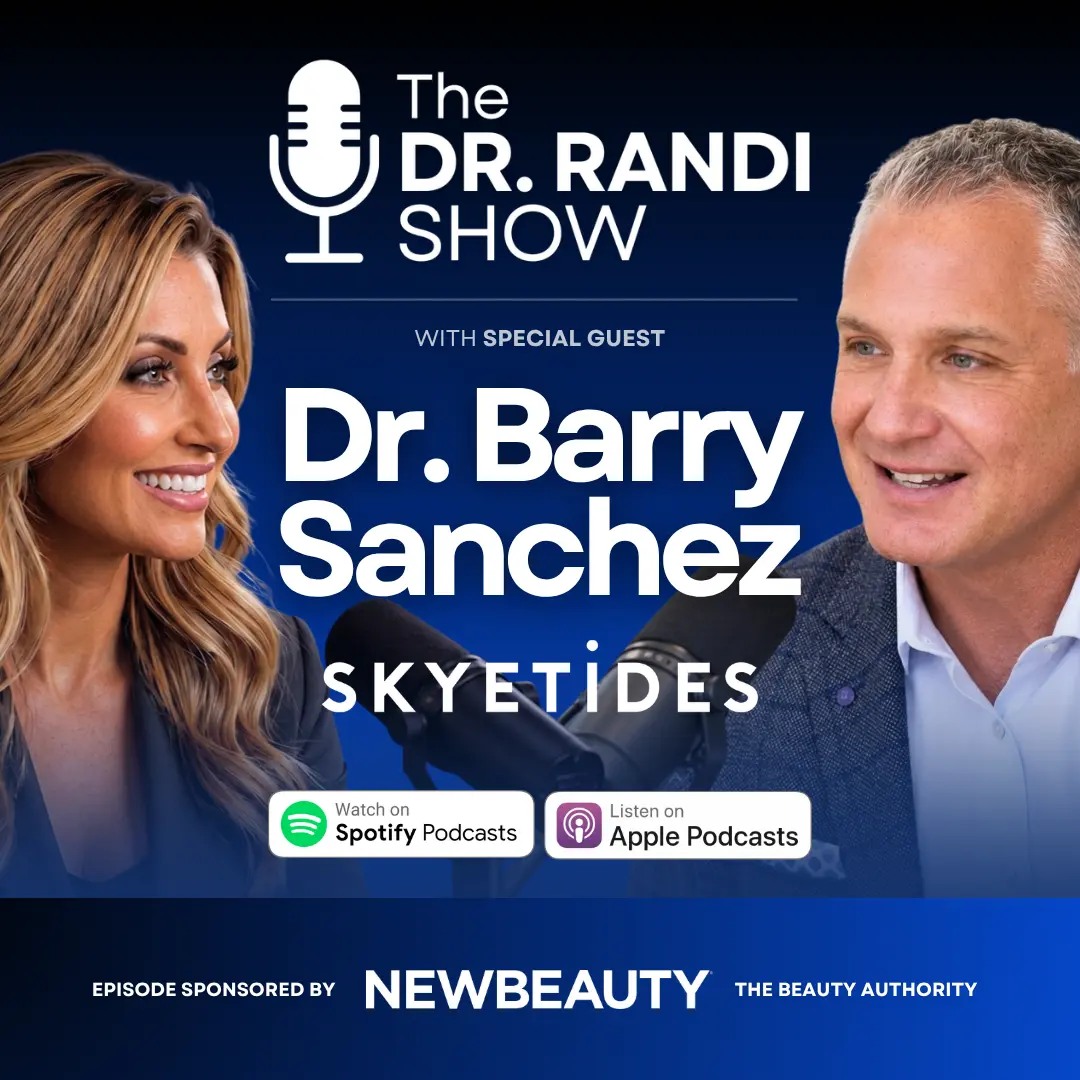
On this episode of The Dr. Randi Show, Dr. Randi Boyette sits down with Dr. Ryan Beal, the entrepreneur behind a skin delivery technology that is creating major interest across performance medicine, wellness, and aesthetics.
Before aesthetics took notice, the technology was already being used by professional sports organizations and elite athletes focused on performance and recovery. Today, that same science is being explored for applications ranging from topical fat reduction and peptide delivery to the future potential of needle-free neurotoxins.
Dr. Beal shares how a breakthrough originally developed to help deliver molecules through the skin evolved into something far bigger—opening the door to new possibilities in aesthetics, recovery, inflammation, and personalized medicine.
In this episode, Dr. Randi and Dr. Ryan Beal discuss:
• Why every NFL team and most NBA and NHL organizations adopted this technology for performance and recovery
• The science behind delivering molecules through the skin
• The future of topical fat reduction and body contouring
• Why peptide delivery remains one of the biggest opportunities in medicine
• The connection between inflammation, aging, and recovery
• Why the most powerful treatments of the future may look more like a lotion than an injection
Could the next major breakthrough in aesthetics have less to do with discovering new treatments and more to do with how they’re delivered?
Dr. Beal believes the answer is yes.
Sponsored by NewBeauty 💄
📱 Listen and Watch on Spotify: https://spti.fi/y6w3U2J
🎧 Listen Now on Apple: https://dub.sh/qRuxo4Y
Episode FAQ
What is transcutaneous drug delivery, and how could it change aesthetics and medicine?
On this episode of The Dr. Randi Show, guest Dr. Ryan Beal, founder of Dyve Biosciences, describes a transcutaneous delivery platform that treats the skin as a delivery system rather than only a barrier. Dr. Ryan Beal explains that the technology moves active molecules deeper into the skin, and in some cases into circulation, without damaging the skin and across a broader range of molecules than traditional transdermal approaches. He shares that what began as a skincare idea evolved into a wider drug delivery platform with applications spanning athletic recovery, aesthetics, longevity, and oncology.
How can active ingredients be delivered through the skin without needles?
Dr. Beal explains that the skin is an excellent barrier, designed to keep water in and everything else out, which is why getting a meaningful dose of active ingredients through it has been difficult for decades. On the episode, he describes Dyve’s approach as functioning like a needle through sophisticated biochemistry rather than anything mechanical or physical, getting molecules in without damaging the skin and across a wider set of molecules than older transdermal methods, which were largely limited to very small, slightly lipophilic, highly potent compounds. Dr. Beal frames the focus as the cases where a pill is not enough or a needle does not work well.
What is PR Lotion, and why do professional sports teams use it?
Dr. Beal shares that PR Lotion, now marketed by Momentous, is a topical that buffers lactic acid, or more precisely the lactate and acid that muscles generate during hard exertion. He recounts that the idea started at his kitchen table in a cereal bowl when he was an endurance athlete looking to improve performance and, especially, recovery from delayed onset muscle soreness (DOMS). According to Dr. Beal, the product was not originally marketed to athletes; they began asking for it, and he says it is now used by every NFL team, most or all NBA and NHL teams, much of the professional cycling peloton, and weekend athletes.
Can topical fat reduction replace injections for body sculpting, and how far away is it?
Dr. Beal describes targeted fat reduction, or adipolysis, delivered as an at-home topical rather than through injections. On the episode he shares that Dyve has completed initial human studies in both targeted fat reduction and melasma, that these would likely be prescription products needing additional studies before approval, and that he expects them within the next couple of years. He contrasts a once or twice daily topical with a current approach of roughly 30 to 40 injections once a month over four to six months. Dr. Beal presents this as his company’s expectation and personal experience, not a guaranteed outcome.
Why does needle-free delivery matter, and how does it relate to GLP-1s and fear of needles?
Dr. Beal points to a study cited on the show finding that over 25% of the US population has a true fear of needles, and he notes that even people without that fear would often prefer to avoid needles if they could do so without sacrificing efficacy. He suggests needle-free topical options could expand who receives treatments, including GLP-1 related and other injectable therapies, and could serve as at-home care that supplements an injectable. Dr. Beal frames this as rethinking how aesthetic and medical treatments are delivered rather than a single product category.
Is a topical alternative to injectable neurotoxins possible?
Dr. Beal shares that Dyve has done initial work on delivering toxins through the skin and has seen promising early results, but he is careful not to minimize the challenge, because neuromodulators and neurotoxins are large proteins that are difficult to move through the skin. He describes topical toxins as further out than targeted fat reduction or melasma, while expressing confidence that if anyone can solve it, his team can. Dr. Beal presents this as work in progress rather than an available treatment.
How are inflammation and pH linked to skin aging and longevity?
Dr. Beal describes the future of longevity as centered on anti-inflammation, and specifically anti-inflammation you can apply topically. He explains a loop in which inflammation creates acidity and acidity drives inflammation, and that because the body is designed to work at normal pH, tipping slightly acidic can have large downstream effects on conditions like rosacea, redness, reactive skin, hyperpigmentation, and aging itself. On the episode he connects this to why some people report reduced inflammation on GLP-1s after significant weight loss, since a heavier body is under more stress. Dr. Beal shares his view that resetting this pH and inflammation balance is a major lever for both how people feel and how they look.
Can peptides be delivered through the skin?
Dr. Beal shares that peptides are a major opportunity but also a real challenge, because many are large molecules well outside what is typically delivered through the skin with traditional approaches. He notes that he fields two to five inbound inquiries a week about topical peptides and says Dyve has done substantial R&D and feels confident in its ability to deliver them. Even so, Dr. Beal explains that peptides are not the company’s current commercial focus, because the team is prioritizing execution on an already full development plate.
How did this delivery technology become relevant to cancer treatment?
Dr. Beal shares a deeply personal story: he is a cancer survivor who lost both parents to cancer, including his mother to pancreatic cancer in 2023. He recounts being diagnosed with a rare tumor after going to the ER during a 120 mile ultra race in Colorado, and then going through chemotherapy, open heart surgery (a sternotomy), and radiation. Dr. Beal explains that this experience galvanized his mission to apply Dyve’s delivery science to oncology, including the idea of buffering the acidity around a tumor, and that the company is moving into its first in human trials with Moffitt Cancer Center later this year. He describes this as his personal experience and motivation, not a proven treatment.
What will delivery technology and biology look like in five to ten years?
Dr. Beal predicts that in five to ten years people will open their medicine cabinet and find that the most powerful medicines look much more like a lotion than a needle. He argues that personalized medicine and biomarkers will only matter if the delivery problem is solved, and that many custom peptides, proteins, and molecules are not well suited to injection or to oral routes. Dr. Beal shares his view that if pH proves drugable, much of what we accept about aging, inflammation, and recovery is up for renegotiation.