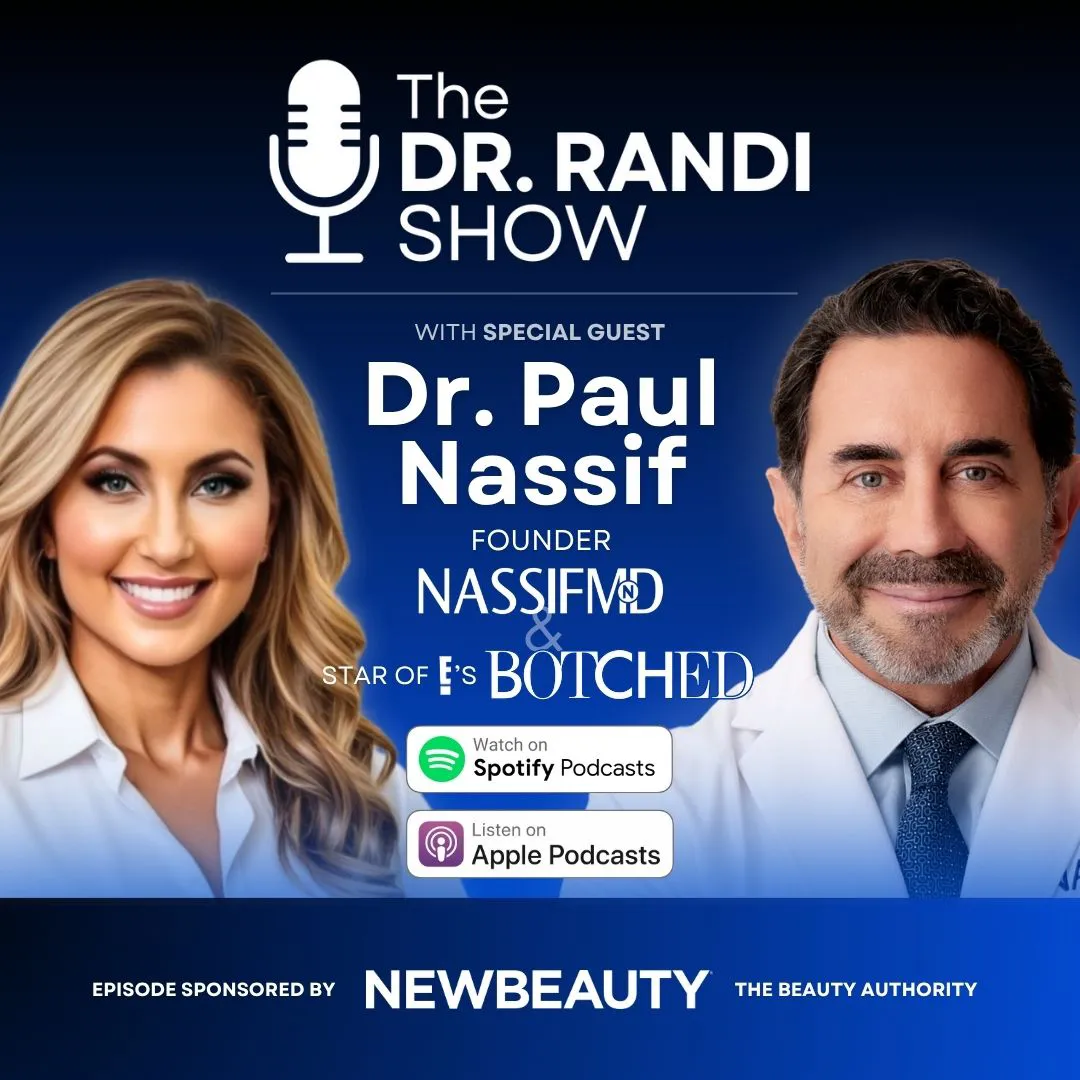
He’s the world-famous surgeon who fixes what others won’t touch—and the breakout star who made Botched a global phenomenon. Now, Dr. Paul Nassif sits down with Dr. Randi for a no-filter conversation about the faces you know, the procedures you don’t, and the truth behind the trends taking over your feed.
From the surge in facial surgeries among younger patients to the psychological toll of filter culture, Dr. Nassif shares what he’s really seeing behind the consultation curtain. He opens up about when he says no, what’s fueling the demand for “preventative” facelifts, and why Gen Z is showing up for brow lifts and eyelid tweaks.
We also go deep on the cultural evolution of beauty, the hidden impact of GLP-1 meds, and how his NassifMD skincare—developed through years of surgical experience—is giving patients a smarter way to recover and maintain. NassifMD Dermaceuticals
Smart, sharp, and loaded with real talk—this episode is your all-access pass to one of the most recognized surgeons in the world.
This episode is sponsored by NewBeauty💄
📱Watch on Spotify: https://spti.fi/N3ZVjsm
🎧Listen on Apple Podcasts: https://apple.co/453pLG6
Episode FAQ
What makes a comprehensive facelift approach different from surgery alone?
On this episode of The Dr. Randi Show, facial plastic surgeon Dr. Paul Nassif, known from the TV show Botched, explained how he moved from a reputation built on revision rhinoplasty to focusing heavily on facelifts and aging face rejuvenation. Dr. Paul Nassif described his approach as combining three parts: surgery to lift and restore facial structure at a deep level, skincare to prep the skin before surgery and support healing afterward, and non-surgical treatments such as a little neurotoxin, conservative filler, or superficial radiofrequency or ultrasound. In his view, the scalpel can only go so deep, so pairing these pieces with a trained aesthetic eye is what helps results look natural and last. This reflects Dr. Nassif’s clinical experience and is not medical advice.
How do plastic surgeons handle patients who want surgery they do not need?
On The Dr. Randi Show, Dr. Paul Nassif shared that in his practice roughly one out of five patients who come in are not candidates for what they are asking for. Rather than simply turning them away, Dr. Paul Nassif said he tries to pivot, suggesting a different option or explaining the problems a requested procedure could cause. He described himself as a tough love kind of surgeon who is comfortable being blunt and telling a patient that enough is enough. This reflects Dr. Nassif’s clinical experience and is not medical advice.
Are beauty and facelift expectations different in LA, New York, and the Middle East?
On The Dr. Randi Show, Dr. Paul Nassif said that Los Angeles and New York patients once wanted noticeably different looks, with New York historically favoring a more stylized, surgical result. Over roughly the last seven years, Dr. Paul Nassif has seen the two coasts come together around wanting to look refreshed and natural rather than having oversized lips or cheeks. He also noted that his Middle Eastern patients, who once often requested a pinched, ski slope nose or a high brow, are now asking to breathe better and look natural, with growing interest in deep plane facelifts and neck lifts. He stressed that surgeons treating international patients should understand and preserve cultural features that matter to each patient. This reflects Dr. Nassif’s clinical experience and is not medical advice.
Why does skincare before and after facial surgery matter?
On The Dr. Randi Show, Dr. Paul Nassif explained that his NassifMD skincare line grew out of his operating room, with the goal of prepping skin before procedures or lasers and supporting healing afterward. Dr. Paul Nassif said hydrated, resilient skin is more pliable, easier to operate on, and tends to recover more smoothly than dehydrated skin, comparing it to working with a plump grape versus a dried raisin. He added that after a deep plane facelift, skincare can help address neck texture, fine lines, and discoloration in areas where an intense laser may not be an option, because results look better when the skin looks better. This reflects Dr. Nassif’s clinical experience and is not medical advice.
Can filler migrate, and can energy based treatments make a future facelift harder?
On The Dr. Randi Show, Dr. Paul Nassif said that during deep plane facelifts he is seeing facial fillers travel to other parts of the face, such as filler placed in the tear trough being found near the jawline, and he urged caution even with hyaluronic acid fillers. Dr. Paul Nassif also said he is seeing deeper ultrasound, radiofrequency, and deep microneedling treatments create scar tissue in the deeper layers, which in his experience can make a later deep plane facelift harder and possibly riskier. He predicted, while noting he could be wrong, a shift over the coming years toward more superficial energy treatments, more conservative filler use, and natural options such as PRF and fat grafting. In the episode’s speed round, he named radiofrequency microneedling as the most overrated treatment right now. This reflects Dr. Nassif’s clinical experience and is not medical advice.
Can dissolving filler also break down your own natural hyaluronic acid?
On The Dr. Randi Show, Dr. Paul Nassif raised a concern about filler reversal with hyaluronidase, the enzyme used to dissolve hyaluronic acid filler. Dr. Paul Nassif noted that the body already contains its own natural hyaluronic acid, for example in the cheeks, and said he suspects that dissolving filler may also break down some of that natural hyaluronic acid. He was clear that his view is anecdotal rather than based on established science yet, and his advice was simply to be careful. This reflects Dr. Nassif’s clinical experience and is not medical advice.
How young is too young for a facelift, lip lift, or eyelid surgery?
On The Dr. Randi Show, Dr. Paul Nassif said he is seeing younger patients request facelifts, lip lifts, upper eyelid surgery, and brow lifts, a trend he connects to social media filters and what he calls filter dysmorphia. Dr. Paul Nassif said a facelift at 29 is far too young and can risk poor scarring, while a mini lift in the early forties is something he is comfortable with, and he named 46 as his facelift sweet spot. He shared that he recently told an 18 year old no to a lip lift. For younger patients he recommends great skincare and less invasive options, noting that a flat no often sends them to someone who will operate, so the goal is to work with them and delay surgery until it is appropriate. This reflects Dr. Nassif’s clinical experience and is not medical advice.
Is filter dysmorphia still driving cosmetic surgery requests?
On The Dr. Randi Show, Dr. Paul Nassif said filter dysmorphia was a major topic when Botched was airing, and that about two years earlier patients were regularly bringing in heavily edited phone photos that looked almost unrecognizable. Dr. Paul Nassif said he still sees it, especially with younger patients and requests involving the nose, brows, or lips, but feels it is starting to die down. In the speed round, he named body dysmorphia as the one patient red flag he will not ignore. This reflects Dr. Nassif’s clinical experience and is not medical advice.
How are GLP-1 weight loss medications like Ozempic affecting the face and body?
On The Dr. Randi Show, Dr. Paul Nassif said many people he knows have lost significant weight on GLP-1 medications such as semaglutide, and that there is both good and bad to it. Dr. Paul Nassif cautioned that weight loss can mean losing muscle as well as fat, so he suggests eating plenty of protein, exercising, and lifting weights, and he warned that losing weight too fast can leave loose skin that leads some people to seek more plastic surgery, often called Ozempic face. At the same time, he said these medications may make many people healthier by reducing cardiovascular, blood pressure, blood sugar, and joint burdens, especially for people with obesity, and he believes they are here to stay. His overall message was to do it the right way. This reflects Dr. Nassif’s personal and clinical perspective and is not medical advice.
What is next in aesthetics and facelift surgery?
On The Dr. Randi Show, Dr. Paul Nassif shared three areas he is focused on for the future. Dr. Paul Nassif said he is working on preservation techniques for the deep plane facelift that aim for faster healing and a less invasive approach while still delivering a beautiful lift, along with regenerative injectables made from a patient’s own blood, cells, or fat, and the next level of clinical grade skincare. He mentioned that he already uses fat grafting and nano fat, which he described as containing multipotent stromal cells, to help with skin texture during facelifts, and that his newest NassifMD launch pairs niacinamide with biopeptides, which he said includes 120 peptides, for texture, tone, and fine lines. This reflects Dr. Nassif’s clinical experience and is not medical advice.