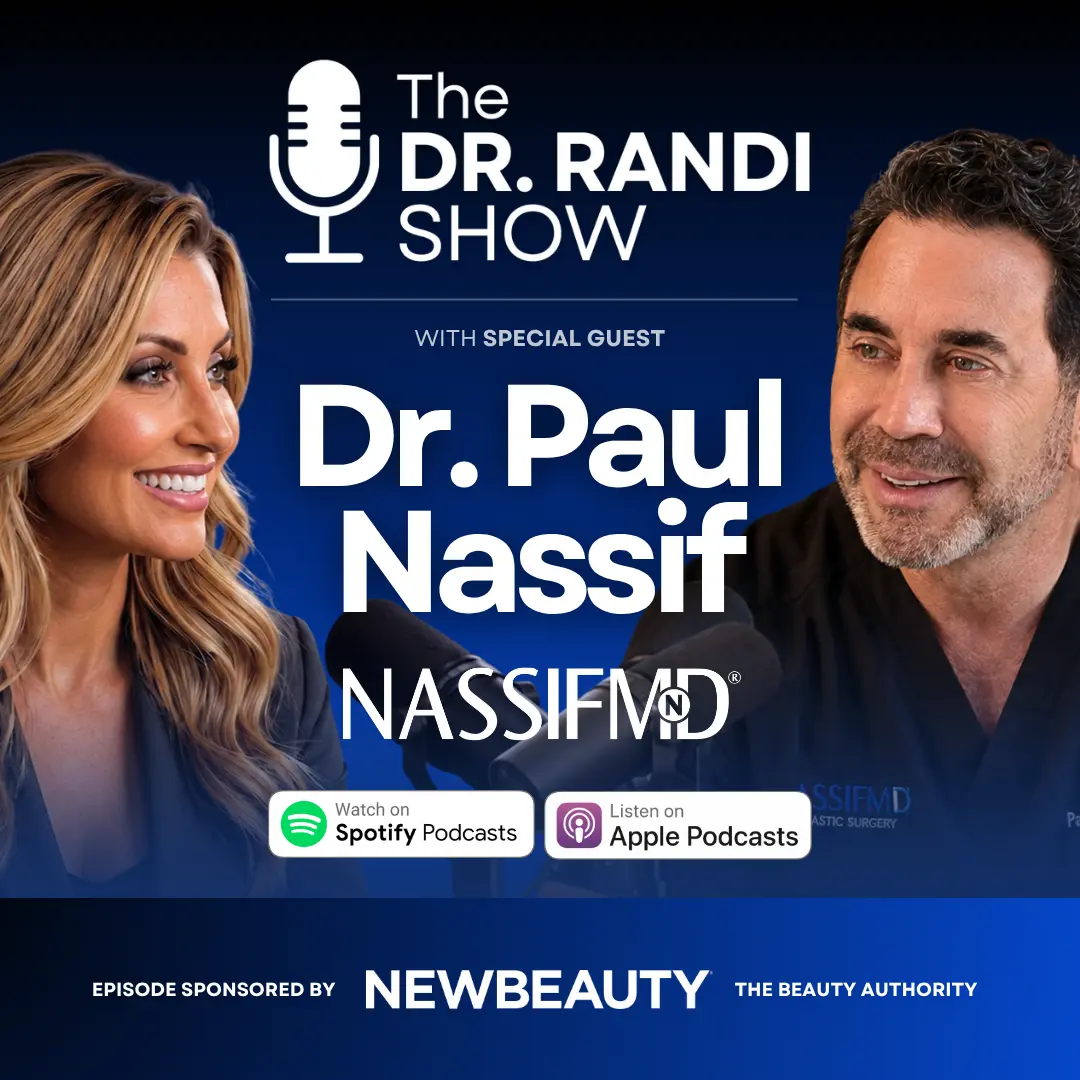
Dr. Paul Nassif returns to The Dr. Randi Show for a conversation that goes far beyond what viewers see on television. While many know him from Botched, this episode focuses on how he thinks about facial surgery today…what’s changed, what’s misunderstood, and what patients should be paying closer attention to before making decisions.
In this episode, we cover:
• Why everyone is asking for a “snatched neck” and how Dr. Nassif approaches it differently
• Skin health and recovery as the foundation of surgical results, and why Dr. Nassif built his latest products around that belief
• The rise in younger patients seeking procedures and the role of “filter dysmorphia” in shaping expectations
• Dr. Nassif on aesthetic trends patients should avoid
• Dissolving filler: insight, caution, and clinical reality
• How much of Dr. Nassif’s practice is dedicated to revision surgery and why
We also close with a speed round that gives a more personal look at Dr. Nassif: how he thinks, how he works, and what continues to surprise him after years at the top of his field.
This episode is for anyone navigating aesthetic decisions and wanting a clearer, more realistic perspective from someone who sees the long-term outcomes every single day.
Sponsored by NewBeauty 💄
📱 Listen and Watch on Spotify: https://spti.fi/ZJfqLfT
🎧 Listen Now on Apple: https://dub.link/rMt3uBl
Episode FAQ
What are the biggest facial plastic surgery and aesthetics trends going into the new year?
On The Dr. Randi Show, facial plastic surgeon Dr. Paul Nassif, widely known from the TV show Botched, shared how patient questions have shifted heading into the new year. He said the aging face consultation now centers on reducing the size of the submandibular glands for a smoother neck, the hemostatic net technique that supports faster recovery, and growing interest in fat grafting during aging face surgery. He also emphasized caring for the skin from the outside through his skincare and recovery approach, and cautioned that some minimally invasive and energy based treatments can make a later deep plane facelift more difficult. This reflects Dr. Nassif’s personal and professional experience and is not medical advice.
What are submandibular glands, and how does reducing them create a snatched neck?
On The Dr. Randi Show, Dr. Nassif explained that the submandibular glands sit under the jaw and produce saliva, and that in some people they descend with age and create fullness in the neck. He described a deep neck lift as the procedure that addresses this, reducing the muscle underneath, the glands, or the deeper fat to achieve what patients call a snatched neck. In his experience a standard neck lift does not lift those glands, so reducing them is what removes that fullness, and he estimated he performs this on roughly 20 percent of his patients when it fits their goals. This reflects Dr. Nassif’s clinical experience and is not medical advice.
What is the hemostatic net in facelift surgery, and how does it help recovery?
During this episode of The Dr. Randi Show, Dr. Nassif described the hemostatic net as a series of stitches placed on the outside of the skin across the face and neck after a facelift, which stay in for about three days. He said the technique, which he helped popularize alongside colleagues from Brazil, supports faster recovery, lowers the risk of a seroma (fluid collection) or hematoma (blood collection), and may help hold the lift more securely by closing the space created during surgery. He noted the stitches look surgical at first, and that after about two years of using the approach he had not had complaints of lasting marks. This reflects Dr. Nassif’s clinical experience and is not medical advice.
Can non-surgical and energy based treatments make a future facelift more difficult?
On The Dr. Randi Show, Dr. Nassif cautioned that some energy based and minimally invasive treatments, including radiofrequency microneedling, ultrasound devices, and threading, can complicate a later facelift. He explained that these treatments can create fibrosis, or scar formation, in the tissue planes between the skin and the deeper layers, which can obscure the facial nerves and make the lift or fat grafting more challenging, and can affect the blood supply. He also mentioned seeing filler migrate to other parts of the face over time. His main advice was to tell your surgeon exactly which procedures you have had in the past, because that history matters for planning an aging face procedure. This reflects Dr. Nassif’s clinical experience and is not medical advice.
Should you dissolve filler before a facelift, and can you overdo filler reversal?
On The Dr. Randi Show, Dr. Nassif said he does dissolve filler before operating, usually across a couple of visits in the weeks beforehand, using an enzyme that breaks down the hyaluronic acid in the filler. He cautioned, though, that overdoing filler reversal has been documented to disrupt some of the natural hyaluronic acid in the face, which can leave a person looking more hollow than before they started. He also noted that fewer patients are asking to dissolve filler now that word has spread about this risk. This reflects Dr. Nassif’s clinical experience and is not medical advice.
How long do facelift results last, and what affects how long they hold?
On The Dr. Randi Show, Dr. Nassif emphasized educating patients about longevity, explaining that with a deep plane facelift he elevates the deep tissue firmly and lays the skin down gently with minimal tension to avoid scarring. He said how long results last depends heavily on the elasticity and quality of a person’s skin and how they have cared for it over their life, so some people may droop a little sooner than others. He used the image of a conveyor belt, noting that a lift moves you back but you keep aging naturally, and told patients to expect roughly a 70 percent improvement by about six months once the swelling settles. This reflects Dr. Nassif’s clinical experience and is not medical advice.
How are GLP-1 weight loss medications like Ozempic changing the face, and how is lost volume restored?
On The Dr. Randi Show, Dr. Nassif discussed how GLP-1 weight loss medications, including Ozempic, are changing faces as more people use them. He said losing weight too quickly can lead to a sunken, hollow look and loose skin, and that he has seen patients lose too much subcutaneous fat and need a lift or added volume. To restore fullness he described options such as fat grafting using a person’s own fat, along with a newer allograft fat matrix called Alloclae that can be injected when someone has very little fat of their own. He also shared that he personally microdoses a GLP-1 to manage his hemoglobin A1C rather than for weight loss, and stressed going slowly under the guidance of a good doctor. This reflects Dr. Nassif’s personal and clinical experience and is not medical advice.
Why are younger patients seeking cosmetic procedures, and what is filter dysmorphia?
On The Dr. Randi Show, Dr. Nassif said he sees patients of all ages, from their twenties to their sixties, bringing in filtered photos and asking to match that flawless look, a pattern he has previously called filter dysmorphia. He explained that while techniques like fat grafting and nano fat can sculpt the face and improve skin texture, and good skincare and lasers can help skin look its best, no treatment can truly turn a person into their filtered image. His message to patients was that skincare and procedures can get them red carpet ready, but a complete filter look is not realistic. This reflects Dr. Nassif’s clinical experience and is not medical advice.
Why does skin quality and skincare prep matter before and after facial surgery?
On The Dr. Randi Show, Dr. Nassif described a 360 approach that pairs surgery, in office treatments, and skincare, explaining that a facelift repositions tissue but skin quality drives healing, results, and recovery. He said he sends patients a skincare kit to prep their skin for about a month before surgery and has them continue afterward, using steps such as detox pads to prep the skin followed by a recovery focused routine that includes his NassifMD Niacinamide Biopeptide Serum, a face oil, and hydrating creams, along with his NassifMD Hydro-Screen Serum for added hydration and volume. He noted that better prepared, well hydrated skin heals faster and helps the final result look restored, natural, and fresh rather than different. This reflects Dr. Nassif’s clinical experience and is not medical advice.
Can you use too many active ingredients in skincare, and how do you protect your skin barrier?
On The Dr. Randi Show, Dr. Nassif addressed the trend of people overloading their skin with too many actives and damaging their own skin barrier. He said multiple actives can work well when they are formulated to be synergistic, so each one helps the others work better rather than simply adding up, but that stacking strong standalone actives, such as a 10 percent vitamin C alongside several others, can irritate the skin. His advice was to go slowly, patch test a small area with any new product, and layer thoughtfully so the skin barrier stays protected. This reflects Dr. Nassif’s clinical experience and is not medical advice.