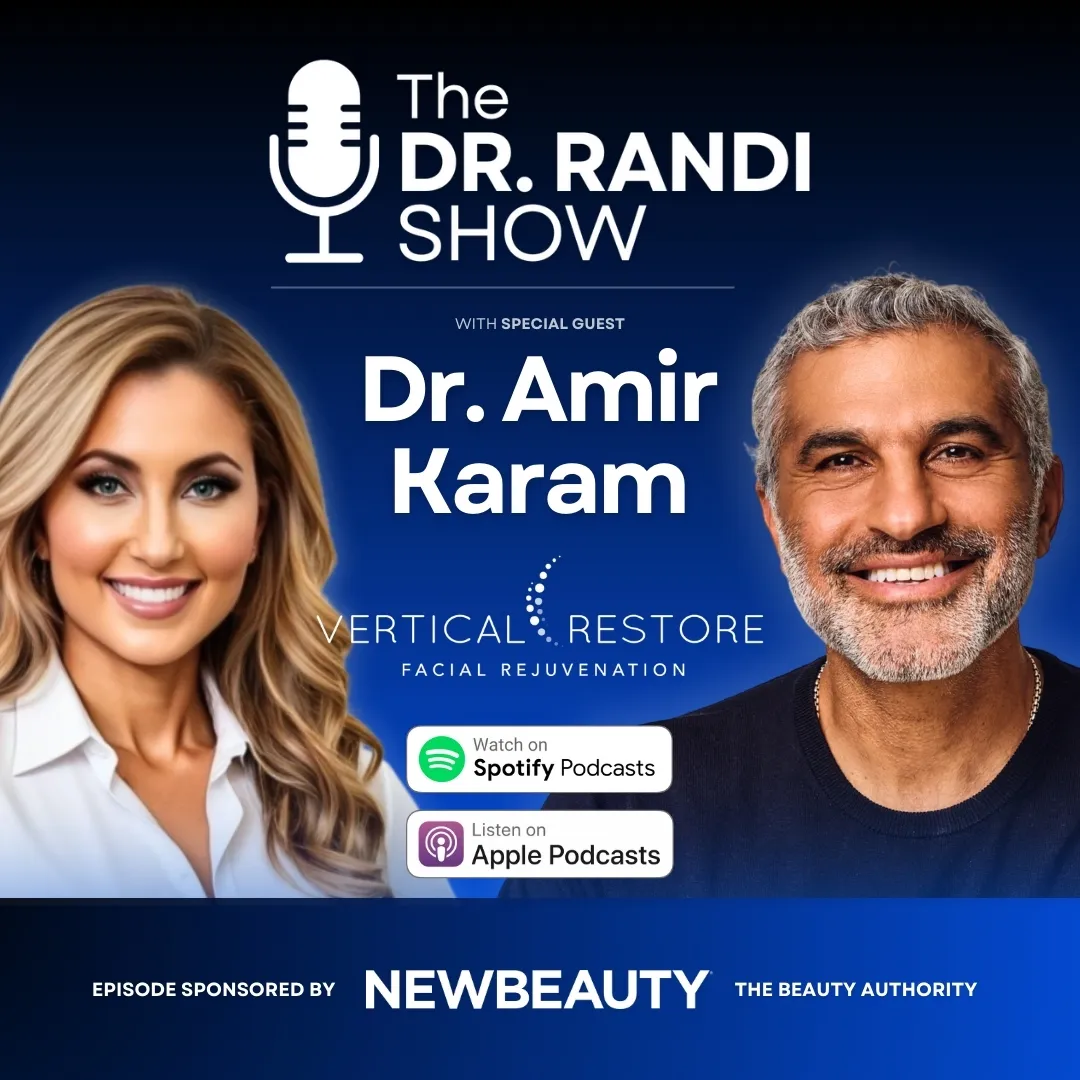
In this episode of The Dr. Randi Show, I sit down with Amir Karam MD to talk about how decades of surgical experience shaped his trademarked Vertical Restore technique and why a vertically focused approach has become central to the way he rejuvenates the face.
Dr. Karam shares how Vertical Restore developed, how he thinks about facial balance and proportion, and why addressing structure, volume, and skin together is essential to achieving results that feel natural and enduring.
We also talk about how patient expectations around facial rejuvenation have evolved, what people are prioritizing today, and how Dr. Karam approaches patient selection and long-term outcomes.
The episode includes a rapid-fire speed round covering today’s most talked-about aesthetic treatments, offering Dr. Karam’s perspective on what he incorporates into practice.
This is the kind of conversation patients search for, surgeons listen closely to, and the industry pays attention to. It may change how you think about aging — and what’s possible.
Sponsored by NewBeauty💄
📱 Listen and Watch on Spotify: https://spti.fi/t5PvvC1
🎧 Listen on Apple Podcasts: https://dub.link/CWRZqB3
Episode FAQ
What is this Dr. Randi Show episode on natural facial rejuvenation and the Vertical Restore facelift about?
In this episode of The Dr. Randi Show, host Dr. Randi Boyette speaks with world renowned facial plastic surgeon Dr. Amir Karam, who shared that he has performed more than 7,000 facial rejuvenation surgeries. He discussed his philosophy of natural, timeless results, the trademarked Vertical Restore facelift he developed, his Karam MD Trifecta skincare line, how patient expectations have shifted, and his cautious approach to new technology. Dr. Karam explained that his goal is to help people look like themselves and years younger rather than looking obviously operated on. This reflects Dr. Karam’s personal and professional experience and is not medical advice.
What is the Vertical Restore facelift and how is it different from a traditional facelift?
On The Dr. Randi Show, Dr. Karam described Vertical Restore as the trademarked facelift he developed to lift the face in a vertical direction, the opposite vector of how the face ages, rather than pulling it horizontally toward the ears as many traditional SMAS facelifts do. He explained that it evolved over time into a deep plane technique, which releases the ligaments and binding tissue so the face can move freely and hold longer than a traditional SMAS lift. In his approach, Vertical Restore addresses the lateral brow, midface, jawline, and neck together, and is combined with fat transfer to replace lost volume and treatments to improve the skin. He said lifting the midface this way helps restore a more youthful, heart shaped look. This reflects Dr. Karam’s clinical experience and is not medical advice.
Who is a good candidate for a Vertical Restore facelift, and who is not?
During this episode of The Dr. Randi Show, Dr. Karam outlined how he evaluates candidacy for Vertical Restore using both physical and emotional criteria. He said the anatomic requirement is that there has to be enough laxity to physically move, so someone who is very young or who has recently had a facelift may have too little to lift. He added that the more subjective side is emotional readiness, where a person feels they no longer look as young as they feel and wants to recapture that, while still holding realistic expectations rather than hoping to look decades younger overnight. In his practice, when those conditions are not met, he gently advises the person to pass on the procedure. This reflects Dr. Karam’s clinical experience and is not medical advice.
Why do some facelifts look natural while others look done or windswept?
On The Dr. Randi Show, Dr. Karam explained that natural looking results come from starting with the right paradigm about how the face ages. In his view, the aging face lengthens as the deeper fascia descends, loses volume, and loses youthful skin quality, so rejuvenation has to address all three at once by treating the skin, replacing volume, and repositioning the soft tissues in the exact opposite direction of aging. He said that decades ago many surgeons pulled the face horizontally toward the ears without addressing volume or skin, which contributed to the tight, windswept look. Combining a vertically oriented lift with fat transfer and skin treatment, along with an artistic sense of what natural looks like, is what he credits for results that look unoperated. This reflects Dr. Karam’s clinical experience and is not medical advice.
Why do people in their 50s, 60s, and 70s consider a facelift, and what do they feel afterward?
On The Dr. Randi Show, Dr. Karam shared that many healthy people carry a mental self image of a much younger version of themselves, so points of reality like a photograph, a mirror, or a video call can create a disconnect that leaves them feeling upset by how they have changed. He said that when that gap is closed, patients often describe a feeling of completeness and reconnection, along with gratitude and joy at seeing a face that matches how they picture themselves. In his experience, that emotional response is one of the most rewarding parts of the field. This reflects Dr. Karam’s personal experience and is not medical advice.
How have patient expectations for facelift results changed with social media?
During the episode of The Dr. Randi Show, Dr. Karam explained that social media and the sharing of before and after results have reset what patients expect. He said that in the past people often accepted a trade off, expecting a tighter but somewhat windswept look that did not quite resemble themselves. Now that the public has seen natural looking outcomes, he said the expectation is to look like themselves and years younger at the same time, which he called a high bar. In his view, the hardest part is delivering that natural result consistently, because every face is different. This reflects Dr. Karam’s clinical experience and is not medical advice.
What is the Karam MD Trifecta skincare line and what does it contain?
On The Dr. Randi Show, Dr. Karam described the Karam MD Trifecta as the three step skincare line he created to bring his surgical philosophy to skin care in a simple, tolerable routine. He said aging skin needs many things at once, such as boosting collagen, reducing pigment, restoring the skin barrier, and adding antioxidants, which used to mean patients juggling around eight separate products they struggled to keep up with. To solve that, he combined roughly 21 actives, including retinol, vitamin C, peptides, niacinamide, ceramides, and botanical lighteners, into a cleanser and two treatment steps used twice a day in a split dose so the skin tolerates ingredients like retinol and vitamin C more easily. He noted the line launched at the end of 2021 and has grown to more than 50,000 customers with about 13,000 daily subscribers. This reflects Dr. Karam’s personal and professional experience and is not medical advice.
Are RF microneedling and non surgical skin tightening devices worth it for lifting sagging skin?
On The Dr. Randi Show, Dr. Karam shared his skeptical view of non surgical devices that claim to lift tissue or improve laxity. He said that in his experience no energy device, thread, or liquid facelift with filler has been a reliable remedy for sagging and tissue descent, and that many treatments simply return under new branding. He mentioned that some patients came to him seeking fat transfer after radio frequency microneedling because they felt the treatment aged them, and he pointed to an FDA statement cautioning that radio frequency microneedling devices can cause problems and that patients should go through the informed consent process. He described himself as never an early adopter, preferring to wait two or three years and rely on candid feedback from trusted colleagues before bringing anything into his practice. This reflects Dr. Karam’s clinical experience and is not medical advice.
How does a facial plastic surgeon build trust and set realistic expectations with patients?
On The Dr. Randi Show, Dr. Karam explained that he builds trust through honesty and candor rather than selling patients on results that will not happen. He said his personal litmus test is whether a treatment is something he would do for his own family member, noting that he operated on his wife, and that he favors options that are high reward and low risk. In his practice, he tries to be straightforward about limitations ahead of surgery so patients understand them beforehand rather than being surprised afterward. He said patients appreciate that authenticity. This reflects Dr. Karam’s personal and professional experience and is not medical advice.
Why is there a renewed trend toward facelift surgery over non surgical treatments?
On The Dr. Randi Show, Dr. Karam said the most notable shift he sees is a growing trend toward facelift surgery after nearly 20 years in which non surgical treatments dominated. He believes this is pushing younger and less experienced surgeons to raise their standards, because patients now expect natural looking results. Rather than a new technology on the horizon, he said the tools for excellent facial rejuvenation largely already exist, and the open question is whether people will follow that direction. For 2026, he shared that his focus is on refining the patient experience and continuing to grow awareness of the Karam MD skincare line rather than chasing anything new. This reflects Dr. Karam’s professional experience and is not medical advice.